English
 عربى
عربى
News
Home / News / Industry News / BW Membranes Explained: What They Are, How They Work, and How to Choose the Right One
If you're involved in water treatment — whether for industrial processes, municipal supply, commercial facilities, or large-scale desalination — you've almost certainly come across the term BW membranes. BW stands for brackish water, and BW membranes are a specific category of reverse osmosis (RO) membrane elements designed to handle water with moderate salinity levels. They sit between seawater membranes (which handle very high TDS) and tap water or low-pressure membranes (which handle very low TDS), making them one of the most widely used membrane types in the water treatment industry. This guide breaks down how they work, what makes them different, and how to choose the right one for your system.
Content
BW membranes — or brackish water reverse osmosis membranes — are semi-permeable membrane elements engineered to remove dissolved salts, contaminants, and impurities from water with a total dissolved solids (TDS) concentration typically ranging from 1,000 to 10,000 mg/L (ppm). This range is what defines "brackish water" — it's saltier than freshwater but significantly less saline than seawater, which typically exceeds 35,000 mg/L TDS.
Sources that fall into the brackish water category include well water and groundwater (very common in arid regions), certain river water near coastal areas where seawater intrusion occurs, industrial process water with moderate mineral content, and water from agricultural drainage or irrigation return flows. In all these cases, the water is too saline or mineral-laden for direct consumption or industrial use without treatment, but doesn't require the extreme operating pressures of seawater desalination systems.
Reverse osmosis BW membranes work by applying hydraulic pressure to force water through a dense semi-permeable membrane. The membrane allows water molecules to pass while blocking the vast majority of dissolved ions, salts, organic molecules, bacteria, and other contaminants. The result is a permeate stream of purified water and a concentrate stream containing the rejected contaminants, which is discharged or further processed.
Understanding where BW membranes sit in the broader landscape of RO membrane types helps clarify when and why to use them. Here's a direct comparison:
| Membrane Type | Feed Water TDS Range | Typical Operating Pressure | Common Applications |
| Tap / Low-Pressure RO | Up to 500 mg/L | 50–150 psi (3.5–10 bar) | Municipal tap water, point-of-use systems |
| BW Membranes | 1,000–10,000 mg/L | 150–600 psi (10–40 bar) | Groundwater, industrial, municipal |
| Seawater (SW) Membranes | 35,000+ mg/L | 800–1,200 psi (55–80 bar) | Ocean desalination plants |
| Nanofiltration (NF) | Varies (softening focus) | 70–300 psi (5–20 bar) | Hardness removal, color reduction |
BW membrane elements operate at significantly lower pressures than seawater membranes, which translates directly into lower energy consumption and reduced system cost. This makes brackish water RO systems far more economical to operate when the feed water salinity is in the brackish range — using a seawater membrane on brackish feed water would be an expensive and unnecessary over-specification.
Most commercial BW RO membranes are manufactured as spiral-wound membrane elements — the dominant configuration in the water treatment industry for medium-to-large scale systems. Understanding the construction helps explain the performance characteristics and maintenance requirements of these components.
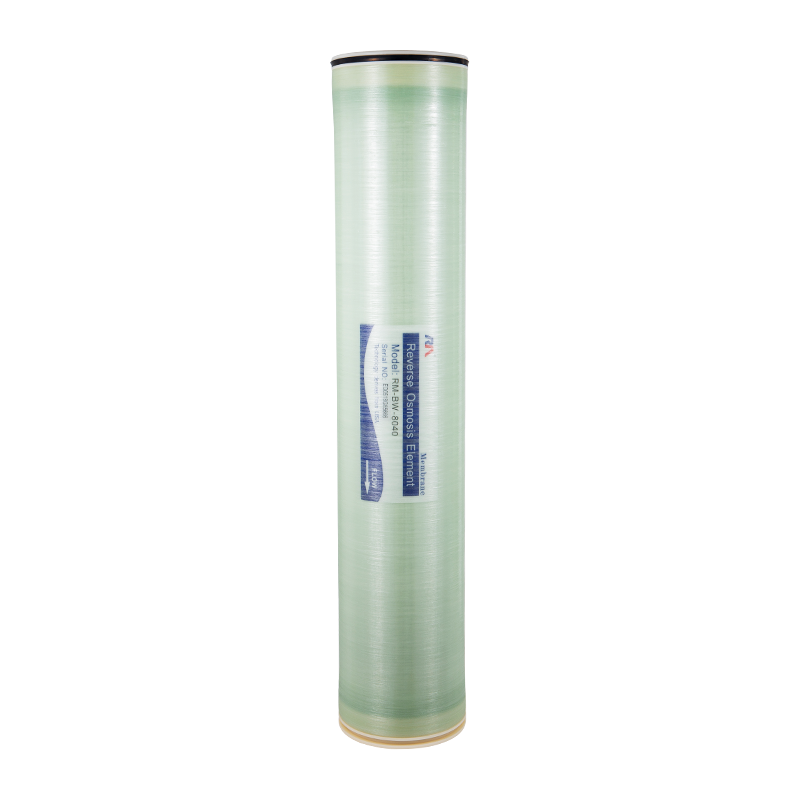
A spiral-wound BW membrane element consists of several layers wound tightly around a central perforated tube. The active separation layer is a thin-film composite (TFC) membrane — typically a polyamide layer around 0.2 microns thick, formed through interfacial polymerization. This polyamide layer is the functional heart of the membrane: it performs the actual ion rejection. Beneath it sits a microporous polysulfone support layer that provides structural integrity, and below that a non-woven polyester fabric backing for mechanical strength.
Sandwiched between membrane layers are feed spacers (plastic mesh that creates channels for the feed water to flow across the membrane surface) and permeate spacers (which channel purified water toward the central collection tube). The entire assembly is wound spirally around the perforated central tube and encased in a fiberglass outer shell. Standard industrial BW membrane elements are 4 inches or 8 inches in diameter and 40 inches long, though other sizes exist for specific applications.
When comparing BW membrane products, several key specifications determine whether a membrane is suitable for a given application. These are typically listed in the manufacturer's product data sheet and are measured under standardized test conditions.
BW membranes are among the most versatile membrane products in the water treatment industry. Their operating pressure range and rejection characteristics make them suitable for a remarkably wide range of applications:
Many municipalities in water-stressed regions rely on groundwater sources with elevated TDS levels that exceed drinking water standards. BW RO systems using brackish water membranes are used to treat this groundwater to potable quality. Large municipal plants may house hundreds of 8-inch BW membrane elements arranged in multi-stage pressure vessel arrays to achieve the required flow capacity and recovery rates.
Power generation, semiconductor manufacturing, pharmaceutical production, and food and beverage processing all require high-purity water that standard municipal supply cannot always provide. BW membrane systems are commonly deployed as the primary desalination stage before further polishing with ion exchange or electrodeionization (EDI) to produce ultrapure water. For boiler feed water, removing dissolved minerals prevents scale formation and extends boiler life significantly.
In arid agricultural regions, irrigation water often has TDS levels that, over time, accumulate salts in the soil and reduce crop yields. BW RO systems can desalinate irrigation water to acceptable levels, protecting soil health and improving productivity. This application has grown significantly in the Middle East, North Africa, and parts of the United States and Australia.
Treated municipal wastewater effluent and industrial wastewater often contain dissolved solids in the brackish range. BW membranes are increasingly used in water reclamation systems that polish secondary or tertiary treated wastewater for reuse in industrial cooling, irrigation, or even indirect potable reuse applications. This is a rapidly growing application driven by water scarcity and sustainability mandates worldwide.
Choosing between the many BW membrane products on the market requires matching membrane characteristics to your specific feed water quality, flow requirements, recovery targets, and operating conditions. Here are the most important selection criteria:
Even the best BW membrane elements will experience performance decline over time without proper maintenance. The two primary mechanisms that reduce membrane performance are fouling (accumulation of biological matter, colloids, or organic compounds on the membrane surface) and scaling (precipitation of sparingly soluble salts like calcium carbonate, calcium sulfate, or silica within the membrane element).
Monitoring normalized permeate flow, salt rejection, and differential pressure across the membrane array gives early warning of developing fouling or scaling issues. A 10–15% decline in normalized flow or a 10–15% increase in differential pressure are typical triggers for cleaning. Chemical cleaning — using acid solutions for scale removal and alkaline or detergent solutions for organic fouling and biofouling — can restore membrane performance to near-original levels if performed promptly. Delayed cleaning allows fouling layers to compact and become much harder to remove, potentially causing permanent performance loss.
Antiscalant dosing upstream of the membrane system is the standard preventive measure against scaling, with dosage rates calculated based on the feed water chemistry and target recovery. Proper pretreatment — including multimedia filtration, cartridge filtration to 5 microns, and dechlorination — is equally essential and directly determines how long BW membrane elements maintain their performance between cleaning cycles and before replacement is needed.
With proper pretreatment, appropriate operating conditions, and timely cleaning, quality BW RO membranes typically last 3 to 7 years before replacement is warranted. Some well-maintained systems report membrane lifespans exceeding 10 years. Performance decline is inevitable as the membrane ages — the active layer gradually becomes more permeable (reducing rejection) while the feed spacers accumulate irreversible fouling (increasing pressure drop). Replacement is indicated when normalized salt rejection falls below acceptable levels despite cleaning, or when differential pressure becomes too high to operate economically. Tracking membrane performance trends using normalized data over the system's operational history is the most reliable way to schedule replacements proactively rather than reactively.