English
 عربى
عربى
News
Home / News / Industry News / Everything You Need to Know About SW Membranes for Seawater Desalination
Content
SW membranes — short for seawater reverse osmosis membranes — are the core filtration elements used in seawater desalination systems. They are designed specifically to handle the extreme salt concentrations found in ocean water, typically ranging from 32,000 to 45,000 parts per million (ppm) of total dissolved solids (TDS). Unlike brackish water or tap water membranes, SW membranes must operate under significantly higher pressures — usually between 55 and 70 bar (800–1,000 psi) — while still delivering high salt rejection rates of 99.6% or above.
The importance of SW membranes extends far beyond technical specifications. As freshwater scarcity becomes a growing global challenge, desalination plants powered by seawater RO membranes have become a critical source of potable water for coastal cities, island communities, industrial facilities, and offshore platforms. Choosing the right SW membrane directly impacts energy consumption, water recovery rates, system longevity, and overall operating costs — making it one of the most consequential decisions in any desalination project.
SW membranes operate on the principle of reverse osmosis (RO). In natural osmosis, water moves from a low-concentration solution to a high-concentration solution through a semi-permeable membrane until equilibrium is reached. Reverse osmosis does the opposite — by applying hydraulic pressure greater than the natural osmotic pressure of seawater (typically around 27 bar), water molecules are forced through the membrane from the high-salinity side to the low-salinity permeate side, leaving dissolved salts, ions, bacteria, and other contaminants behind.
The membrane itself is a thin-film composite (TFC) structure consisting of multiple layers. The outermost layer is a non-woven polyester support fabric that provides mechanical strength. Above that sits a microporous polysulfone mid-layer, and on top is an ultra-thin polyamide active layer — typically only 0.2 microns thick — which performs the actual separation. This active layer is what gives SW membranes their exceptional rejection capabilities while allowing a reasonable water flux to pass through.
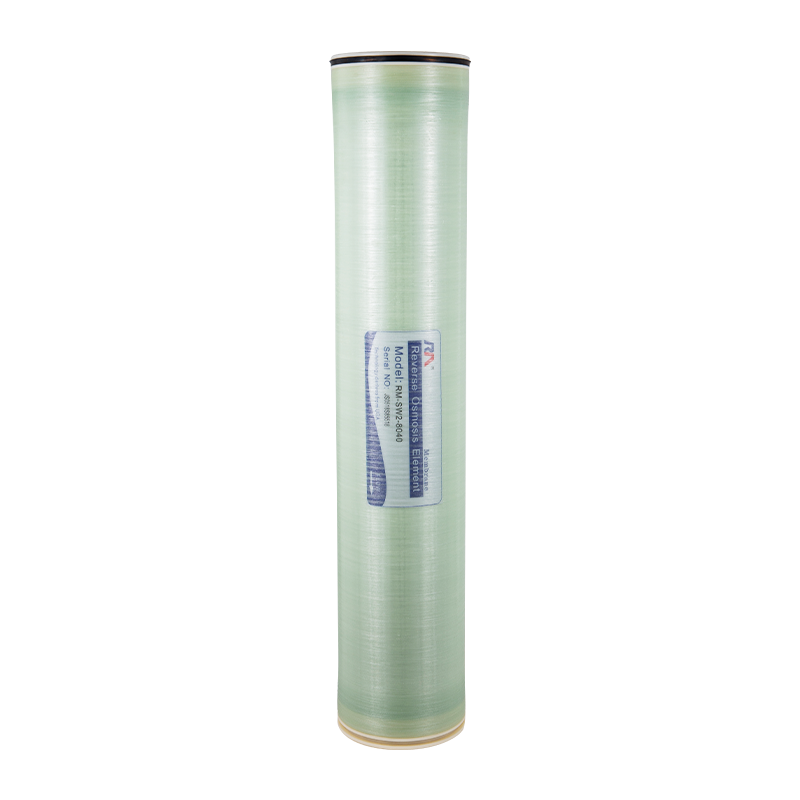
Most SW membranes are manufactured in a spiral wound configuration. Multiple membrane leaves are wrapped around a central permeate collection tube, with feed spacers between each leaf to promote turbulent flow and reduce concentration polarization at the membrane surface. This design packs a large active membrane area — typically 37 to 41 square meters — into a compact 8-inch diameter, 40-inch long element that fits standard pressure vessel housings.
When evaluating SW membranes, several performance parameters define how well a membrane will perform in real operating conditions. Understanding these figures is essential before comparing products or designing a system.
Several manufacturers produce high-quality SW membranes for commercial and industrial desalination applications. Each brand offers a range of products targeting different priorities — from maximum salt rejection to high permeate flow or fouling resistance. The table below summarizes some of the most widely used SW membrane elements available today.
| Model | Manufacturer | Salt Rejection | Permeate Flow | Key Feature |
| SW30HR-380 | DuPont FilmTec | 99.75% | 23.1 m³/day | High rejection, industry standard |
| SW30ULE-400i | DuPont FilmTec | 99.60% | 28.4 m³/day | Ultra-low energy, high flow |
| SWC5-LD | Toray | 99.80% | 21.2 m³/day | Maximum rejection |
| ES20-SW8040F | Nitto (Hydranautics) | 99.70% | 22.7 m³/day | Energy saving, stable flux |
| RE SW-400 | LG Chem | 99.75% | 23.1 m³/day | Consistent performance, competitive price |
DuPont FilmTec's SW30 series remains the most widely deployed line of seawater RO membranes globally, known for long-term stability and broad chemical cleaning tolerance. Toray's SWC5-LD is preferred in applications where the absolute highest rejection is needed — such as pharmaceutical-grade water or systems with very high feed salinity. Hydranautics and LG Chem offer strong alternatives with competitive energy profiles, making them popular choices for large-scale municipal desalination plants where energy savings translate directly to lower operating costs.
Not all seawater sources are the same, and not all desalination applications have identical requirements. Selecting the right SWRO membrane requires a careful match between the membrane's design characteristics and the specific demands of your system.
Before choosing a membrane, conduct a thorough feed water analysis covering TDS, ionic composition (sodium, chloride, sulfate, calcium, magnesium), temperature, pH, SDI (Silt Density Index), turbidity, TOC (Total Organic Carbon), and any biological content. High SDI values above 5 indicate the need for additional pretreatment before the SW membrane stage. High concentrations of calcium and sulfate raise the risk of scaling at elevated recovery rates, which may influence membrane selection toward more fouling-resistant designs.
High-rejection SW membranes produce purer permeate but typically require higher operating pressures, which means more energy per cubic meter of product water. Ultra-low-energy (ULE) SW membranes operate at lower pressures and deliver higher flow rates, reducing specific energy consumption — a critical metric for large-scale plants where electricity is the dominant operational expense. If your product water target is below 500 ppm TDS and your feed salinity is moderate (32,000–35,000 ppm), a ULE membrane may deliver substantial cost savings without compromising water quality.
In a standard single-pass SWRO system, recovery rates of 40–45% are typical. If your design targets higher recovery through a two-pass or second-stage configuration, the concentrate from the first pass becomes the feed for the second — which has much higher salinity and requires membranes rated for that elevated concentration. Some SW membrane models are specifically designed for second-pass or high-salinity service and should be specified accordingly.
The purchase price of an SW membrane element is only a fraction of its total cost over its service life. Membrane replacement frequency, energy consumption, cleaning chemical usage, and pretreatment requirements all add up significantly. A membrane with a slightly higher upfront cost but better fouling resistance and a longer service life of 5–7 years may be far more economical than a cheaper element that needs replacement every 2–3 years or requires more frequent chemical cleaning cycles.
Fouling is the number one operational challenge for seawater RO membrane systems. It refers to the accumulation of material on or within the membrane surface, which reduces permeate flux, increases differential pressure, and can permanently damage the membrane if left untreated. There are four main types of fouling that affect SW membranes:
When preventive measures are insufficient and membrane performance drops — typically defined as a 10–15% decline in normalized permeate flow or a 10–15% rise in normalized salt passage or differential pressure — chemical cleaning in place (CIP) is performed. For scaling, acidic cleaners such as citric acid (2%) or hydrochloric acid solutions at low pH are used. For biological and organic fouling, alkaline cleaners with EDTA, sodium hydroxide, or enzyme-based formulations are effective. It is important to match the cleaning chemical to the confirmed foul type and to follow the membrane manufacturer's approved cleaning procedures to avoid voiding warranties or damaging the membrane structure.
The longevity and efficiency of SW membranes are heavily influenced by what happens before the water ever reaches the membrane element. A well-designed pretreatment train is not optional — it is a prerequisite for sustainable, low-maintenance SWRO operation.
For open ocean intakes, a conventional pretreatment train typically includes coarse screening and fine screening to remove debris, followed by dissolved air flotation (DAF) or clarification to remove suspended solids and algae, dual-media filtration (anthracite and sand) to reduce turbidity, and 5-micron cartridge filtration as the final barrier before the RO membranes. The target SDI of the feed water entering the SW membrane pressure vessels should be below 3, and ideally below 2, to maintain acceptable membrane run times between cleanings.
Ultrafiltration (UF) pretreatment has become increasingly popular as an alternative to conventional media filtration. UF systems consistently deliver SDI values below 1, regardless of variations in raw seawater quality — such as during harmful algal blooms or high-turbidity storm events — and result in significantly longer SW membrane run times and lower chemical cleaning frequency. The higher capital cost of UF pretreatment is often offset by reduced membrane replacement costs and lower overall operating expenses over the plant's lifetime.
One of the most significant advances in seawater desalination over the past two decades has been the widespread adoption of energy recovery devices (ERDs). In a typical SWRO system operating at 45% recovery, the concentrate stream leaving the pressure vessels still carries 55% of the feed volume at near-feed pressure — representing a large amount of hydraulic energy that would otherwise be wasted.
Modern isobaric energy recovery devices, such as pressure exchangers (PX) from Energy Recovery Inc. or turbochargers from Danfoss and KSB, capture this energy and use it to pressurize incoming feed water, reducing the load on the high-pressure pump. This technology reduces the specific energy consumption of an SWRO system from around 6–8 kWh/m³ (without energy recovery) down to 2–3.5 kWh/m³ — a reduction of over 50%. Since energy typically accounts for 30–50% of the total cost of desalinated water, ERDs have a transformative impact on the economics of any system using SW membranes at scale.
The SW membrane industry continues to advance rapidly, driven by the dual pressures of growing global water demand and the need to reduce the energy intensity and environmental footprint of desalination.
Aquaporin membranes incorporate natural protein water channels (aquaporins) into the membrane structure, mimicking how biological cell membranes transport water with extremely high efficiency and selectivity. Commercial aquaporin-enhanced RO membranes are now available from companies like Aquaporin A/S, and ongoing research aims to scale up production while demonstrating consistent long-term performance in seawater applications.
Researchers are actively developing graphene oxide and nanocomposite thin-film membranes that promise significantly higher water permeability than conventional polyamide TFC membranes while maintaining equivalent or superior salt rejection. These materials offer the potential to drastically reduce operating pressures and energy consumption, although commercial deployment at scale remains a work in progress.
The industry is also moving toward larger membrane elements — 16-inch and 18-inch diameter elements are being piloted to reduce vessel count, piping complexity, and footprint for large-scale plants. Simultaneously, digital monitoring platforms that track individual element performance in real time using embedded sensors and AI-driven analytics are being introduced, enabling proactive maintenance decisions and further extending the operational life of SW membrane systems.