English
 عربى
عربى
News
Home / News / Industry News / Nano-filtration Membranes Made Simple: How They Work, Where They're Used, and How to Choose the Right One
Content
Nano-filtration membranes occupy a precise position in the pressure-driven membrane filtration hierarchy — sitting between ultrafiltration (UF) and reverse osmosis (RO) in terms of pore size, operating pressure, and what they retain versus pass through. Their nominal pore size ranges from approximately 0.5 to 2 nanometers, and they operate at trans-membrane pressures of 3–20 bar (45–300 psi), significantly lower than the 15–80 bar typically required for RO systems. This makes nanofiltration a highly energy-efficient alternative to RO in applications where complete desalination is not required but selective ion and molecular removal is.
The defining characteristic of a nanofiltration membrane is its ability to differentiate between solutes based on both size and charge. Unlike RO membranes, which reject virtually all dissolved ions, NF membranes show a strong selectivity toward divalent and multivalent ions (calcium, magnesium, sulfate, heavy metals) while allowing a significant portion of monovalent ions (sodium, chloride, potassium) to pass through. This selective permeability is not just a function of the nanometer-scale pore structure but also of the surface charge of the membrane material — most NF membranes carry a net negative charge at neutral pH, which electrostatically repels negatively charged multivalent anions like sulfate (SO₄²⁻) and phosphate (PO₄³⁻).
This combination of size exclusion and Donnan exclusion (charge-based rejection) makes nanofiltration membranes uniquely suited for applications such as water softening, color removal, micropollutant removal, concentration of dairy streams, and selective recovery of valuable compounds in pharmaceutical manufacturing — all with substantially lower energy input than reverse osmosis.
Understanding the transport mechanisms through NF membranes is essential for predicting performance, troubleshooting rejections, and designing systems that achieve the target separation. Three primary mechanisms govern solute transport through a nanofiltration membrane.
The physical pore size of the NF membrane restricts the passage of molecules and hydrated ions larger than the effective pore diameter. Organic molecules with molecular weight above the membrane's molecular weight cut-off (MWCO) — typically 200–1,000 Daltons for NF membranes — are sterically excluded from permeating. This is why NF membranes are effective at removing natural organic matter (NOM), humic acids, pesticides, pharmaceutically active compounds (PhACs), and dyes, all of which have molecular weights in the 200–2,000 Da range. Smaller hydrated ions like Na⁺ and Cl⁻, which have effective hydrated radii well below the pore size, pass through relatively freely.
Most commercial NF membranes are manufactured from polyamide thin-film composite (TFC) materials and carry a net negative surface charge in the neutral to alkaline pH range. This negative charge creates an electrostatic potential at the membrane surface — the Donnan potential — that strongly repels multivalent anions such as sulfate (SO₄²⁻), phosphate (PO₄³⁻), and arsenate (AsO₄³⁻). The rejection of divalent cations like Ca²⁺ and Mg²⁺ is also elevated because electroneutrality requires that their passage through the membrane be coupled to the rejected anions. This is the primary mechanism behind the water softening capability of NF membranes: hardness ions (Ca²⁺, Mg²⁺) are selectively rejected at 85–98% while sodium and chloride pass through at lower rejection rates of 20–50%, reducing osmotic pressure and energy consumption compared to RO.
A third, less intuitive mechanism is dielectric exclusion, which arises from the difference in dielectric constant between the water confined within the nanometer-scale pore and bulk water. Ions must partially shed their hydration shells to enter the nanopore, which is energetically unfavorable. This effect is more pronounced for multivalent ions (which have larger hydration shells) and contributes to the elevated rejection of divalent species beyond what size exclusion and Donnan effects alone would predict. In practice, dielectric exclusion becomes significant at pore diameters below approximately 1 nm and is most relevant for tight NF membranes operating in low ionic strength feed waters.
Selecting between nanofiltration, reverse osmosis, and ultrafiltration requires a clear understanding of what each membrane technology can and cannot achieve. Here is a side-by-side comparison of the key performance and operating parameters:
| Parameter | Ultrafiltration (UF) | Nanofiltration (NF) | Reverse Osmosis (RO) |
| Pore Size | 2–100 nm | 0.5–2 nm | <0.5 nm (dense) |
| MWCO | 1,000–300,000 Da | 200–1,000 Da | <200 Da |
| Operating Pressure | 0.5–5 bar | 3–20 bar | 15–80 bar |
| Monovalent Salt Rejection | <5% | 20–50% | 95–99.5% |
| Divalent Salt Rejection | <10% | 85–98% | 98–99.8% |
| Organic Molecule Rejection | High (>1,000 Da only) | High (>200 Da) | Very High (>100 Da) |
| Relative Energy Cost | Low | Medium | High |
| Typical Applications | Clarification, virus removal, MBR | Softening, color removal, micropollutants | Desalination, ultra-pure water |
In practice, the decision often comes down to total dissolved solids (TDS) target and energy budget. If the goal is to reduce hardness and remove trace organics from a municipal or groundwater source with a TDS of 500–2,000 mg/L, NF membranes deliver the required performance at 30–50% lower energy than RO. If the application requires drinking water from seawater (TDS 35,000 mg/L) or production of ultrapure water for microelectronics, RO is the only viable membrane option.
The performance and durability of a nanofiltration membrane system are fundamentally determined by the membrane material and how it is packaged into a module. Both decisions have significant implications for cleaning tolerance, chemical resistance, flux stability, and lifecycle cost.
TFC polyamide is the dominant material for commercial NF membranes, used in products from Dow Filmtec (now DuPont Water Solutions), Toray, Hydranautics, and Nitto. The membrane consists of three layers: a polyester support fabric (for mechanical strength), a microporous polysulfone interlayer (for dimensional stability), and a crosslinked aromatic polyamide thin film (40–200 nm thick) formed by interfacial polymerization. The polyamide active layer is responsible for the selectivity and flux characteristics. TFC-PA NF membranes offer excellent rejection performance and high flux but are sensitive to chlorine — even 0.1 ppm free chlorine can degrade the polyamide layer over time, requiring dechlorination of feed water with sodium bisulfite before the membrane system.
Cellulose acetate NF membranes predate TFC-PA technology and are less common in new installations. They offer moderate rejection performance and are notably more tolerant of chlorine (up to 1 ppm continuous), which can simplify feed water disinfection management. However, CA membranes are susceptible to hydrolysis at pH extremes (best operated between pH 4–8) and bacterial attack in warm water systems, limiting their application range compared to TFC-PA. They remain in use in some groundwater softening and sugar industry applications where their chlorine tolerance is valued.
Ceramic nanofiltration membranes — based on materials such as alumina (Al₂O₃), titania (TiO₂), or zirconia (ZrO₂) — represent a growing segment of the NF market for harsh industrial applications. They offer outstanding chemical resistance (tolerating pH 0–14, strong oxidants, solvents, and high temperatures up to 400°C), mechanical robustness, and very long operational lifetimes of 10–20 years. Their primary drawbacks are significantly higher capital cost (5–10× that of polymeric membranes) and lower packing density per unit volume. Ceramic NF membranes are favored in applications such as solvent dehydration, high-temperature textile effluent treatment, and aggressive food processing streams involving repeated acid/caustic CIP cycles.
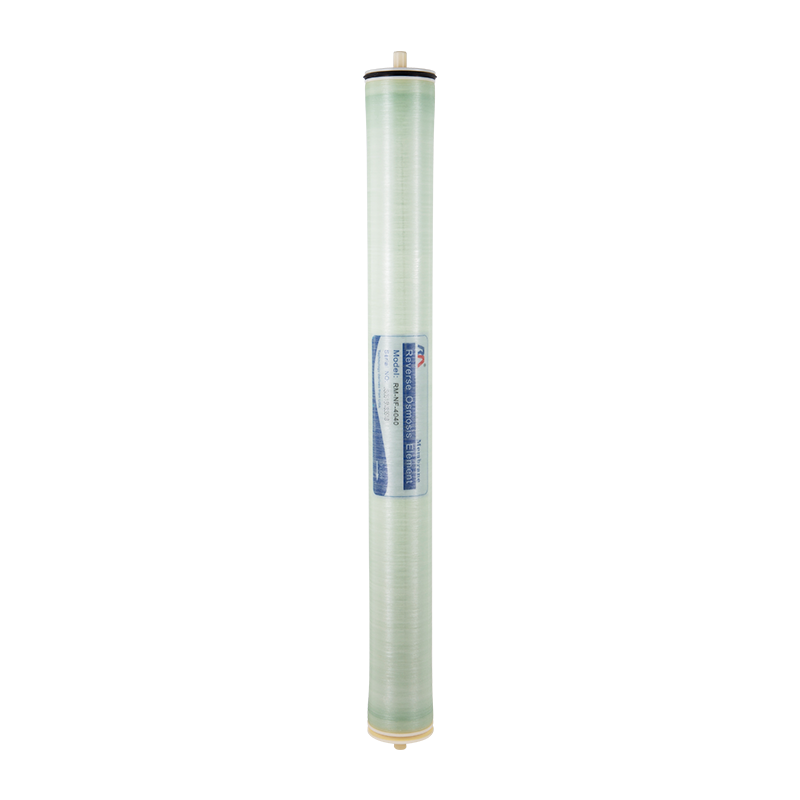
The vast majority of polymeric NF membranes are packaged in spiral wound modules — the same format used for RO. A spiral wound NF element consists of membrane envelope sheets wound around a central permeate collection tube, with feed spacers and permeate spacers separating the layers. Standard sizes are 2.5", 4", and 8" diameter by 40" length, with 8" × 40" elements being the workhorse format for municipal and industrial NF systems. Spiral wound modules achieve very high packing density (typically 800–1,000 m² membrane area per m³ module volume) and are cost-effective for large-scale installations. Hollow fiber NF modules are used in specific applications requiring inside-out flow or backwashability, such as some water treatment pre-treatment and dairy concentration systems, but are less prevalent than spiral wound for mainstream NF.
The selective separation capability of NF membranes has made them indispensable in a wide range of industries. Here are the most important application areas with specific details on what is being separated and what performance is expected.
NF membranes are the most energy-efficient technology for producing softened drinking water from hard groundwater or surface water. A typical municipal NF softening system achieves 85–98% rejection of calcium and magnesium while recovering 75–85% of the feed water as permeate (the remainder being concentrate discharged or further treated). The permeate TDS is typically reduced from 500–800 mg/L to 150–300 mg/L, with hardness below 2°dH — soft enough to eliminate scaling in distribution systems and household appliances without the salt and regeneration waste associated with ion exchange softening. Plants in Florida, the Netherlands, and parts of China have operated NF softening systems at municipal scale for over 20 years with excellent reliability records.
Emerging contaminants — including pesticides, herbicides, pharmaceutically active compounds (PhACs), endocrine disruptors, and per- and polyfluoroalkyl substances (PFAS) — are increasingly detected in surface water and groundwater supplies at concentrations that conventional treatment processes cannot reliably reduce to regulatory limits. NF membranes achieve greater than 90% rejection of most micropollutants with molecular weights above 200 Da, making them one of the most effective barriers for these contaminants. For PFAS specifically, NF membranes with tight MWCO (200–300 Da) achieve PFOA and PFOS rejection above 95%, which is critical given that regulatory limits in the EU and US have been tightened to the sub-10 ppt level.
Humic and fulvic acids — the primary components of natural organic matter (NOM) responsible for the yellow-brown color of surface water — have molecular weights predominantly in the 500–5,000 Da range and are efficiently retained by NF membranes. Color rejection of 95–99% is routinely achieved, producing a permeate with UV254 absorbance below 0.02 cm⁻¹. This is particularly valuable for water utilities in Scandinavia, Canada, and the UK where high-NOM, low-turbidity surface waters present challenges for conventional coagulation-based treatment. NOM removal also reduces disinfection by-product (DBP) formation potential, since humic substances are the precursors for trihalomethanes (THMs) and haloacetic acids (HAAs) generated during chlorination.
In dairy processing, nanofiltration membranes are used to concentrate whey and demineralize it simultaneously — a process called partial demineralization or "nano" in the industry. Sweet whey from cheese production contains lactose, whey proteins, and minerals. NF membranes reject lactose (molecular weight 342 Da) and whey proteins at very high rates while passing a significant fraction of monovalent minerals (NaCl), reducing the ash content of the whey concentrate by 25–35% compared to evaporation alone. This NF-concentrated whey is used in infant formula, sports nutrition products, and functional food applications where controlled mineral content is required. NF also reduces the volume of whey to be spray-dried, saving significant energy compared to evaporation of dilute whey.
Textile effluents are among the most challenging industrial wastewaters, containing reactive dyes with molecular weights of 300–1,500 Da, salts (NaCl, Na₂SO₄) at high concentrations (50–200 g/L), and hydrolyzed dye compounds. NF membranes are highly effective at rejecting dyes (typically >98%) while passing a significant portion of the sodium chloride salt through — enabling a process called "salt/dye separation" that allows both water and salt to be recycled back into the dyeing process. This closes the water and salt loop in the dyehouse, reducing freshwater consumption by 50–80% and salt procurement costs significantly. Tight NF membranes with MWCO around 300 Da are preferred for reactive dye applications.
In pharmaceutical manufacturing, nanofiltration membranes are used for concentration and diafiltration of APIs (active pharmaceutical ingredients), peptides, antibiotics, and vitamins in the 200–2,000 Da molecular weight range. Key advantages over evaporative concentration include ambient temperature processing (preventing thermal degradation of heat-sensitive APIs), no phase change (maintaining aqueous solution integrity), and excellent scalability. NF is also used for solvent exchange (replacing one solvent with another via diafiltration), impurity removal, and process water purification. Regulatory requirements for pharmaceutical membrane systems include compliance with FDA 21 CFR Part 11 for data integrity, USP Class VI material certification for product-contact surfaces, and validated cleaning and integrity testing protocols.
When specifying NF membranes for a new system or replacing membranes in an existing installation, these are the technical parameters that determine whether the membrane will meet performance targets and provide acceptable service life.
Fouling — the deposition and accumulation of material on or within the NF membrane — is the primary operational challenge in nanofiltration systems. Uncontrolled fouling leads to flux decline, increased trans-membrane pressure, reduced rejection, and shortened membrane life. Understanding the fouling mechanism is essential for selecting the right pre-treatment and cleaning strategy.
As water is concentrated in the NF system, sparingly soluble salts — particularly calcium carbonate (CaCO₃), calcium sulfate (CaSO₄), barium sulfate (BaSO₄), and silica (SiO₂) — can exceed their solubility limits and precipitate on the membrane surface as scale. Calcium carbonate scaling is the most common form and is controlled by lowering feed water pH to 6.0–6.5 (converting HCO₃⁻ to CO₂) or by dosing antiscalant chemicals (polycarboxylate or phosphonate-based inhibitors at 2–5 ppm) that interfere with crystal nucleation and growth. Langelier Saturation Index (LSI) and Stiff-Davis Saturation Index calculations should be performed for every NF system design to quantify scaling risk in the concentrate stream.
Natural organic matter, proteins, oils, and surfactants can adsorb onto the polyamide membrane surface and form a gel layer that increases hydraulic resistance. Organic fouling is particularly problematic in surface water NF applications with high NOM concentrations and in dairy NF systems. Pre-treatment with coagulation/flocculation, granular activated carbon (GAC) adsorption, or UF pre-filtration significantly reduces organic fouling load on the NF membrane. Caustic cleaning with NaOH at pH 11–12 (plus surfactants for oil fouling) is the standard protocol for organic foulant removal during CIP.
Biofilm formation on NF membranes — caused by bacterial adhesion, growth, and extracellular polymeric substance (EPS) production — is one of the most difficult fouling modes to control because biofilms are inherently resistant to chemical cleaning. Biofouling reduces flux, increases differential pressure across the membrane element, and in severe cases can physically damage the membrane and spacer materials. Control strategies include maintaining free chlorine in the feed up to the dechlorination point (to limit biofilm formation in pre-treatment piping), periodic shock dosing of non-oxidizing biocides compatible with the membrane (e.g., DBNPA, isothiazolone), and regular CIP with biocidal agents. Keeping feed spacers clean through adequate cross-flow velocity and periodic forward flush cycles also reduces biofouling accumulation rate.
Colloidal particles (clay minerals, iron hydroxides, silica colloids) and suspended solids in the feed water can block feed spacer channels and accumulate on the membrane surface. The Silt Density Index (SDI) is the standard feed water quality parameter used to predict colloidal fouling risk for spiral wound NF systems — an SDI below 3 is typically required, with below 1 preferred for high-flux systems. Pre-treatment to achieve target SDI involves multimedia filtration, cartridge filtration (5–20 µm absolute), and in challenging cases, UF pre-filtration to reduce SDI to below 0.5 reliably.
A nanofiltration membrane is only one component of a complete NF system. The pre-treatment train upstream and the concentrate management strategy downstream are equally important determinants of system performance, membrane life, and total operating cost.
At a minimum, NF feed water should pass through 5 µm cartridge filtration immediately before the high-pressure pump to protect membrane elements and pump components from particulate damage. For surface water feeds, coagulation, sedimentation, and multimedia filtration are standard pre-treatment steps to reduce turbidity and NOM loading. For groundwater with elevated iron or manganese, oxidation and filtration upstream of the NF system prevents these metals from fouling the membrane surface as hydroxide precipitates. pH adjustment and antiscalant dosing are applied just before the NF membranes based on the scaling analysis results. Dechlorination with SMBS is essential for TFC polyamide membranes receiving chlorinated municipal water.
System recovery — the fraction of feed water that becomes permeate — is a critical design parameter for NF systems. Higher recovery means less water wasted as concentrate and lower specific energy consumption per cubic meter of product water. However, higher recovery also means higher concentration factors in the concentrate stream, increasing scaling and fouling risk. Typical NF system recoveries are 75–85% for municipal water applications and 50–70% for more challenging industrial feeds. Stage configurations (two or three pressure vessel banks in series, with recirculation) are used to maximize recovery while managing concentration polarization across individual membrane elements. System design software (such as DuPont WAVE, Toray DS2, or LG Chem RODESIGN) should be used to model recovery and validate the design against scaling indices and individual element flux limits.
The concentrate (reject) stream from an NF system contains all the rejected species at elevated concentrations — typically 4–7× the feed concentration for a system running at 75–85% recovery. Disposing of this concentrate is a significant consideration, particularly for large municipal NF plants. Options include discharge to surface water (subject to regulatory permits for hardness, sulfate, and conductivity limits), blending with wastewater treatment plant influent, deep well injection, evaporation ponds in arid regions, or treatment with zero liquid discharge (ZLD) equipment such as brine concentrators and crystallizers. For industrial NF systems processing high-value streams, the concentrate may itself be the product — for example, in dairy NF where the concentrated whey stream is the desired output and the permeate (containing diluted salts) is discharged or reused.
Nanofiltration membrane science and engineering is an active research and commercialization field. Several developments are moving from laboratory to commercial scale and will shape NF system capabilities over the coming decade.