English
 عربى
عربى
News
Home / News / Industry News / Everything You Need to Know About Ultrafiltration Membranes: How They Work and Why They Matter
Content
An ultrafiltration membrane is a type of pressure-driven filtration barrier designed to separate particles, macromolecules, and microorganisms from liquids based on physical size. Unlike chemical treatments that alter the composition of water or fluids, UF membranes work purely through mechanical exclusion — if a particle is larger than the membrane's pores, it simply cannot pass through. This makes ultrafiltration an exceptionally clean and reliable separation technology with no chemical byproducts.
The pore sizes of ultrafiltration membranes typically range from 0.01 to 0.1 micrometers (or roughly 10 to 100 nanometers), placing them between microfiltration membranes (larger pores) and nanofiltration membranes (smaller pores) in the membrane spectrum. At this scale, UF membranes are fine enough to block bacteria, viruses, proteins, colloids, and suspended solids, while still allowing water, salts, and small organic molecules to pass through freely.
The driving force behind the process is transmembrane pressure (TMP) — typically between 1 and 10 bar — which pushes the feed liquid through the membrane. The filtered liquid that passes through is called the permeate, while the concentrated stream of rejected materials is called the retentate or concentrate. This two-stream output is fundamental to how all pressure-driven membrane systems operate.
Not all UF membranes are built the same. They differ in material composition, physical configuration, and internal structure, and the right choice depends heavily on the application. Here's a breakdown of the most common types:
The physical form of the membrane also varies based on how it's packaged into a usable module:
| Configuration | Description | Best For |
| Hollow Fiber | Thousands of thin, straw-like fibers bundled together; water flows inside-out or outside-in | Municipal water treatment, large-scale systems |
| Flat Sheet | Flat membrane layers arranged in a plate-and-frame or cassette format | Food & beverage, lab-scale applications |
| Spiral Wound | Flat sheets wound around a central permeate tube; compact and high surface area | Industrial water recycling, wastewater pretreatment |
| Tubular | Larger-diameter tubes; easy to clean but lower surface area per unit volume | High-fouling feeds, slurries, pulp & paper |
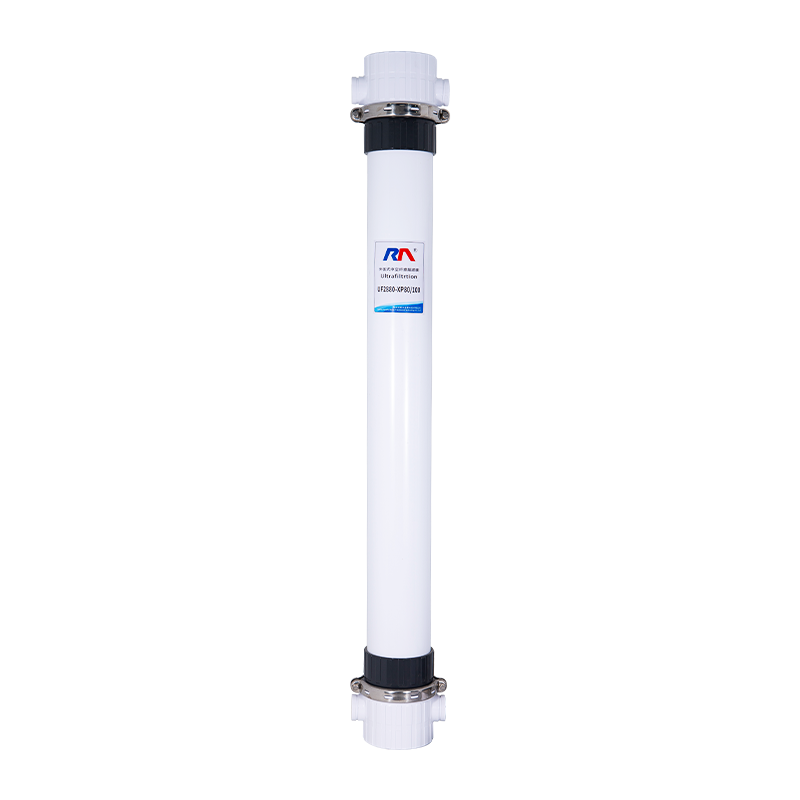
Hollow fiber membranes dominate the water treatment market because of their exceptionally high surface-area-to-volume ratio, which means more filtration capacity in a smaller footprint. A single hollow fiber module can pack thousands of fibers, each with an inner diameter of less than 1 millimeter, into a compact housing.
Understanding where UF fits in the broader filtration landscape is essential for selecting the right technology. Membrane filtration methods are usually compared by their molecular weight cutoff (MWCO) and the types of contaminants they remove:
| Method | Pore Size | What It Removes | Operating Pressure |
| Microfiltration (MF) | 0.1 – 10 µm | Suspended solids, bacteria, some protozoa | 0.1 – 2 bar |
| Ultrafiltration (UF) | 0.01 – 0.1 µm | Bacteria, viruses, proteins, colloids, macromolecules | 1 – 10 bar |
| Nanofiltration (NF) | 0.001 – 0.01 µm | Divalent ions, small organics, hardness | 3 – 20 bar |
| Reverse Osmosis (RO) | < 0.001 µm | Nearly all dissolved salts, ions, and organics | 10 – 80 bar |
The key takeaway is that ultrafiltration membrane systems occupy a strategic middle ground — tighter than microfiltration (so they remove viruses and proteins that MF misses) but much less energy-intensive than reverse osmosis. This makes UF an excellent standalone solution for many applications, and an ideal pretreatment step before RO systems, dramatically reducing fouling and extending the life of downstream membranes.
The versatility of UF membrane technology means it finds use across a surprisingly wide range of industries. Below are some of the most significant real-world applications:
Municipal water treatment plants around the world have adopted hollow fiber ultrafiltration as a primary or secondary treatment step. UF membranes reliably remove Cryptosporidium, Giardia, bacteria, and viruses to levels that meet or exceed regulatory standards — without relying on chemical disinfection alone. Compared to conventional sand filtration and chlorination, UF offers more consistent pathogen removal and a smaller operational footprint. Many modern waterworks use UF as a pretreatment step before UV disinfection or chlorination, reducing chemical dosage requirements.
In the context of water scarcity, UF membrane bioreactors (MBRs) have become a cornerstone technology for wastewater treatment and reuse. An MBR integrates biological treatment with membrane filtration in a single step, producing a high-quality effluent suitable for non-potable reuse in irrigation, industrial cooling, or even indirect potable reuse. The UF membrane in an MBR replaces the secondary clarifier of conventional activated sludge plants, saving space and improving effluent quality dramatically.
The food industry relies heavily on ultrafiltration membranes for concentration and fractionation without heat — making it ideal for heat-sensitive products. Specific uses include:
In biopharma, UF membranes — often called ultrafiltration/diafiltration (UF/DF) systems — are used to concentrate and purify therapeutic proteins, monoclonal antibodies, vaccines, and enzymes. The ability to remove buffer salts via diafiltration while retaining the protein of interest is critical to the final formulation of biologics. Because these applications demand stringent purity and sterility, pharmaceutical-grade UF membranes undergo rigorous validation and are manufactured under cleanroom conditions.
Industries from electronics manufacturing to textiles use UF membranes to treat process water and effluent streams. In semiconductor fabrication, ultrapure water produced partly through UF processes is essential for chip washing steps. In the oil and gas sector, UF is used for produced water treatment. Electrocoat (e-coat) paint operations rely on UF to recover paint particles from rinse water, reducing waste and recovering valuable materials.
One of the most significant operational challenges for any ultrafiltration membrane system is fouling — the accumulation of materials on or within the membrane that reduces permeate flux (flow rate) and increases the pressure required to maintain throughput. Fouling is essentially an unavoidable consequence of the filtration process, but it can be managed effectively with the right strategies.
Operators use a layered approach to keep fouling under control and extend membrane service life:
When evaluating or operating a UF membrane system, several technical parameters define performance and dictate operational decisions:
Ultrafiltration membrane technology continues to evolve rapidly, driven by tightening water quality regulations, growing demand for sustainable water management, and advances in materials science. Several emerging trends are shaping the next generation of UF systems:
Researchers are incorporating nanoparticles — including silver nanoparticles, graphene oxide, titanium dioxide (TiO₂), and zeolites — into polymer membrane matrices. These nanocomposite UF membranes can achieve simultaneously improved permeability, antifouling resistance, and even antimicrobial activity. TiO₂-embedded membranes, for example, can photocatalytically degrade organic foulants under UV light, effectively making the membrane self-cleaning.
Inspired by biological cell membranes, aquaporin-based membranes incorporate natural or synthetic water channel proteins into a lipid or polymer matrix. Aquaporins are extraordinarily efficient water transporters, and early commercial versions of these biomimetic UF membranes have demonstrated exceptional water permeability with very high selectivity — though scaling up production remains a challenge.
For decentralized water treatment in low-resource settings, gravity-driven membrane (GDM) systems operate UF membranes at very low, constant hydraulic pressure with no backwashing or chemical cleaning. While flux is lower than pressurized systems, a stable biological fouling layer (called a biofilm or Schmutzdecke) paradoxically helps maintain permeate quality over time. These systems are being developed for rural and humanitarian water supply applications in Africa and Asia.
Smart UF systems are emerging that integrate advanced oxidation processes (AOPs) for micropollutant removal — targeting pharmaceuticals and endocrine-disrupting compounds that UF alone cannot remove. Simultaneously, artificial intelligence and machine learning algorithms are being applied to predict fouling events, optimize cleaning cycles, and reduce energy consumption in large-scale UF plants — transforming operations from reactive to genuinely predictive.
Selecting the appropriate UF membrane requires a systematic evaluation of several factors. There is no universal "best" membrane — the right choice depends on your specific feed water characteristics, product quality requirements, operational constraints, and budget. Here's a practical framework:
Ultrafiltration membrane technology has matured into one of the most reliable and versatile tools in water treatment and industrial separations. Whether deployed in a municipal waterworks, a biopharmaceutical plant, or a remote village, the core principle remains the same: a precisely engineered barrier that lets the right things through while keeping the wrong things out. As materials science and process engineering continue to advance, UF membranes will only become more efficient, more durable, and more accessible — making clean water and high-purity products available to more people and industries than ever before.