English
 عربى
عربى
News
Home / News / Industry News / Nano-filtration Membranes: How They Work, What They Remove, and Where They're Used
Content
Nano-filtration membranes are a class of pressure-driven semi-permeable membrane filters that occupy the separation range between ultrafiltration (UF) and reverse osmosis (RO) in the membrane filtration spectrum. They are characterized by pore sizes in the range of approximately 1 to 10 nanometers — hence the "nano" designation — and a molecular weight cutoff (MWCO) typically between 200 and 1,000 Daltons. This size range makes nanofiltration membranes uniquely effective at rejecting divalent and multivalent ions, natural organic matter (NOM), micropollutants, and molecules in the lower end of the dissolved organic range, while allowing monovalent ions such as sodium and chloride to pass through at relatively high rates. This selective permeability is a defining characteristic that distinguishes NF membranes from both UF membranes (which remove larger particles but pass most dissolved ions) and RO membranes (which reject virtually all dissolved species).
The transport mechanism in nano-filtration membranes is governed by a combination of size exclusion (physical sieving based on molecular or ionic size relative to membrane pore dimensions), electrostatic repulsion (Donnan exclusion, in which the fixed surface charges on the membrane repel ions of the same charge, particularly multivalent ions), and solution-diffusion transport (where solutes dissolve into and diffuse through the dense polymer matrix of the active layer). The relative contribution of each mechanism depends on the specific membrane material, its surface charge density, the ionic strength of the feed solution, and the target solutes. This multi-mechanism separation behavior gives nanofiltration membranes a nuanced selectivity profile that can be exploited to achieve separations — such as softening water while retaining monovalent salt for downstream processes — that neither UF nor RO can match economically.
The performance of a nanofiltration membrane is fundamentally determined by its physical structure and the chemical nature of its constituent materials. Modern NF membranes are almost universally asymmetric composite structures, meaning they consist of multiple distinct layers — each serving a specific functional role — rather than a single homogeneous film.
The dominant nanofiltration membrane architecture in commercial use today is the thin film composite (TFC) structure, which consists of three layers. The top active layer is an ultra-thin (typically 50–200 nm thick) dense polyamide film formed by interfacial polymerization directly on the surface of the support layer. This polyamide layer contains the nanofiltration separation function — its crosslinked polymer network determines pore size, surface charge, and solute rejection characteristics. Beneath the active layer is a microporous support layer, usually cast from polysulfone (PSf) or polyethersulfone (PES), which provides mechanical stability for the fragile active layer while contributing minimal hydraulic resistance. The bottom layer is a non-woven polyester fabric backing that gives the membrane module structural integrity and handleability during fabrication and operation. The separation performance of a TFC nanofiltration membrane is almost entirely determined by the chemistry and thickness of the polyamide active layer, which is why interfacial polymerization formulation is a closely guarded aspect of membrane manufacturing know-how.
While polyamide TFC is the dominant material for commercial nanofiltration membranes in water treatment, alternative materials are used where specific chemical resistance, temperature tolerance, or separation characteristics are required. Cellulose acetate (CA) nanofiltration membranes offer good chlorine tolerance — a significant advantage over polyamide, which is extremely sensitive to oxidizing biocides — but have limited pH tolerance and a narrower operating temperature range. Sulfonated polyethersulfone (SPES) membranes carry higher fixed negative surface charge than standard polyamide, making them more effective at rejecting sulfate and other multivalent anions. Ceramic nanofiltration membranes — typically alumina (Al₂O₃), titania (TiO₂), or zirconia (ZrO₂) with functionalized surfaces — offer exceptional chemical and thermal stability, making them suitable for aggressive industrial process streams, solvent filtration, and high-temperature applications where polymeric membranes would degrade. Ceramic NF membranes carry a significant cost premium over polymeric alternatives but deliver service lives measured in decades rather than years in demanding environments.
The rejection profile of a nanofiltration membrane — what it removes and what it passes — is more nuanced than that of either UF or RO membranes and is one of the primary reasons for specifying NF over those alternatives. Understanding what nanofiltration membranes retain versus what permeates through them is essential for matching the technology to the right application.
Selecting between nanofiltration, ultrafiltration, and reverse osmosis membranes is one of the most consequential decisions in designing a membrane separation system. Each technology has a distinct capability profile, operating pressure range, and energy requirement, and the right choice depends on precisely which solutes must be removed, which must be retained, and what the system energy and operating cost budget allows.
| Parameter | Ultrafiltration (UF) | Nanofiltration (NF) | Reverse Osmosis (RO) |
| Pore size | 1–100 nm | 0.5–10 nm | <0.5 nm (dense) |
| MWCO | 1,000–300,000 Da | 200–1,000 Da | <100 Da |
| Operating pressure | 0.5–5 bar | 3–20 bar | 10–80 bar |
| Divalent ion rejection | Low (<20%) | High (90–98%) | Very high (>98%) |
| Monovalent ion rejection | Very low (<5%) | Low–moderate (10–70%) | High (95–99.5%) |
| NOM / organics rejection | Moderate (size-dependent) | High (85–99%) | Very high (>99%) |
| Energy consumption | Low | Low–moderate | High |
| TDS reduction | Minimal | Moderate (partial) | Near-complete |
Nanofiltration is the preferred choice when the target is removal of hardness, NOM, sulfates, or micropollutants from a low-to-moderate salinity feed without the energy cost and complete demineralization of RO. It is not appropriate when full desalination or high rejection of monovalent ions is required, and it is more energy-intensive than UF, making UF the better choice when only particulate, colloidal, and microbial removal is needed without dissolved ion removal.
Nanofiltration membranes are deployed across a wide range of industries, each exploiting a different aspect of the membrane's selective rejection profile. The following applications represent the most significant commercial uses of NF membrane technology today.
Municipal drinking water treatment is the largest single application for nanofiltration membranes. In surface water treatment, NF membranes remove natural organic matter, color, taste and odor compounds, pesticides, and disinfection by-product precursors — all of which are inadequately controlled by conventional coagulation, flocculation, and sand filtration processes. In groundwater treatment, NF membranes are used specifically for water softening, where the removal of calcium and magnesium hardness eliminates the need for chemical softening with lime or sodium carbonate, reducing chemical consumption, sludge generation, and operational complexity. The energy requirement for NF water treatment — typically 0.3 to 0.8 kWh per cubic meter for low-salinity groundwater — is significantly lower than RO, making NF the preferred membrane technology where full desalination is unnecessary.
Nanofiltration has extensive applications in dairy processing, where it is used to concentrate whey and milk permeate, partially demineralize whey, and recover lactose. In whey processing, NF membranes concentrate the dilute whey stream from cheese production, reducing volume and transportation costs before downstream evaporation and spray drying. Simultaneously, the partial passage of monovalent salts (Na⁺, K⁺, Cl⁻) through the NF membrane while retaining lactose and proteins allows a degree of demineralization — typically 25–35% mineral reduction — that improves the flavor profile of whey protein concentrates and infant formula ingredients. In wine production, NF membranes are used for alcohol reduction and tartrate stabilization. In sugar processing, NF is applied to purify and concentrate process streams. In all food applications, membranes must comply with food-contact material regulations and be cleanable with food-grade sanitizing agents.
In pharmaceutical manufacturing, nanofiltration membranes are used for the concentration and purification of active pharmaceutical ingredients (APIs), removal of impurities and reaction by-products, solvent exchange, and desalting of protein and peptide solutions. The ability of NF membranes to retain molecules in the 200–1,000 Dalton range while passing smaller salts and solvents makes them particularly valuable in the purification of antibiotics, peptides, and small-molecule drugs. Pharmaceutical-grade NF membranes must meet stringent extractables and leachables specifications and be validated under regulatory frameworks such as FDA 21 CFR or EMA guidelines. The trend toward continuous manufacturing in pharmaceutical production is driving growing adoption of membrane processes, including nanofiltration, as replacements for batch chromatography and evaporation steps.
Nanofiltration membranes are used in industrial wastewater treatment for the removal of heavy metals, dyes, and organic micropollutants from textile, electroplating, and chemical process effluents. In the textile industry, NF membranes remove reactive dyes (molecular weight 300–1,500 Da) from dyehouse effluent with rejection rates above 95%, enabling both meeting discharge limits and recovering and reusing process water. In mining and hydrometallurgy, NF membranes selectively separate sulfate from process streams, enabling sulfate management without the full desalination associated with RO. Lithium recovery from brines — a rapidly growing application driven by battery technology demand — uses NF membranes to selectively pass lithium ions (monovalent) while rejecting magnesium ions (divalent), enabling a separation that is chemically difficult and expensive to achieve by other means.
Offshore oil and gas platforms use seawater injection to maintain reservoir pressure, but the injected water must be treated to remove sulfate ions to prevent barium sulfate and strontium sulfate scale formation in the reservoir — a process called sulfate removal or sulfate reduction treatment (SRT). Nanofiltration membranes are the standard technology for offshore sulfate removal, rejecting sulfate (SO₄²⁻, a divalent anion) at rates above 99% while passing sodium chloride (NaCl) and avoiding the osmotic pressure penalty of full RO desalination. Offshore NF systems must be compact, corrosion-resistant, able to operate on unsteady power supplies, and resistant to biofouling in the warm, nutrient-rich seawater environment.
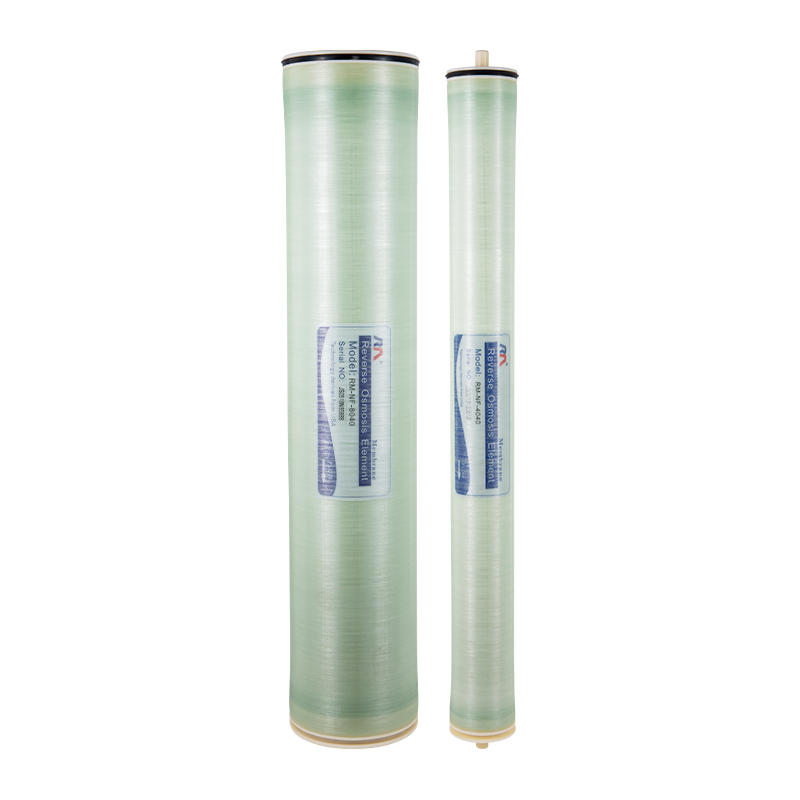
Nanofiltration membranes are incorporated into pressure vessels as membrane modules — standardized assemblies that provide a large membrane area in a compact, mechanically robust package compatible with high-pressure process piping. The choice of module configuration affects system compactness, ease of cleaning, susceptibility to fouling, and replacement cost.
Spiral wound modules are the dominant configuration for commercial nanofiltration systems in water treatment, food processing, and most industrial applications. A spiral wound NF module is constructed by sandwiching flat sheet membrane between two layers of feed-side spacer mesh and a permeate-side carrier fabric, then rolling the assembly tightly around a central perforated permeate collection tube. The resulting cylindrical element — typically 2.5, 4, or 8 inches in diameter and 40 inches long — is loaded into a standardized pressure vessel. Feed water enters one end of the module, flows along the feed spacer channels, and permeate passes through the membrane and spirals inward to the central collection tube. Spiral wound modules offer the best balance of packing density (membrane area per module volume), cost per unit area, and standardization, but they are sensitive to particulate fouling and require good pretreatment to achieve design flux and service life targets.
Hollow fiber nanofiltration modules contain thousands of fine-bore fibers (inner diameter typically 0.5–2 mm) bundled and potted within a cylindrical shell. Feed can be applied either to the inside (lumen side) of the fibers or to the outside (shell side), depending on the application and fouling risk. Inside-out feed provides better flow distribution and easier hydraulic cleaning, while outside-in feed offers better fouling tolerance for higher-turbidity streams. Hollow fiber NF modules offer a very high packing density and can be backwashed — a significant operational advantage for fouling control — but are more susceptible to fiber breakage under pressure surges or abrasive feed conditions than spiral wound modules.
Tubular NF modules — in which membrane is cast on the inside of porous support tubes — are used for highly viscous, high-turbidity, or particulate-laden feed streams that would rapidly foul spiral wound or hollow fiber modules. They are common in food and beverage processing (fruit juice concentration, dairy), pulp and paper effluent treatment, and industrial chemical processing. Plate-and-frame configurations are the most fouling-tolerant module design, as the flat membrane sheets can be mechanically cleaned, but they have low packing density and high cost and are used only for niche applications where their fouling tolerance justifies the premium. For most large-scale NF applications, spiral wound modules in pressure vessels offer the best economics and are the standard industry choice.
Membrane fouling — the accumulation of material on or within the membrane that reduces permeate flux and may alter rejection characteristics — is the central operational challenge in any nanofiltration system. Managing fouling effectively is critical to maintaining system productivity, achieving design service life for membrane elements, and controlling operating costs. Understanding the types of fouling and the appropriate prevention and remediation strategies for each is essential for any NF system operator.
When selecting a nanofiltration membrane for a specific application, the following performance and operational parameters must be evaluated and matched to the process requirements. Relying on a single headline specification such as NaCl rejection without examining the full parameter set is a common source of misspecification.
Nanofiltration membrane technology is an active area of materials science and process engineering research, driven by the dual imperatives of improving separation performance and reducing energy consumption in water treatment and industrial processing. Several significant developments are shaping the next generation of NF membrane products and systems.
Incorporating engineered nanoparticles into the polyamide active layer or the polymer support structure creates nanocomposite NF membranes with enhanced properties relative to conventional TFC membranes. Zeolitic imidazolate frameworks (ZIFs), metal-organic frameworks (MOFs), graphene oxide (GO) sheets, carbon nanotubes (CNTs), and TiO₂ nanoparticles have all been incorporated into NF membrane active layers with reported improvements in permeability (sometimes dramatically), selectivity, antifouling performance, photocatalytic self-cleaning capability, and antibacterial activity. While many of these advances have been demonstrated at laboratory scale, scaling up nanocomposite membrane production to commercial quantities while maintaining the performance enhancements observed in the laboratory remains a significant engineering challenge that several research groups and start-ups are actively working to overcome.
Biological water channel proteins called aquaporins enable near-frictionless water transport across cell membranes with extremely high selectivity. Incorporating aquaporin proteins into synthetic lipid bilayers or block copolymer membranes creates biomimetic NF membranes with extraordinarily high water permeability — several orders of magnitude higher than conventional polymeric membranes — while maintaining excellent ion rejection. Aquaporin-based NF membranes have been commercialized by several companies and are available for specific water purification and pharmaceutical processing applications, though they currently carry a significant cost premium and have limitations in operating pressure range and chemical tolerance that restrict their use to applications where their exceptional permeability justifies the additional cost.
Beyond simple removal of contaminants, there is a growing focus on using nanofiltration membranes as tools for resource recovery — capturing valuable ions, organic compounds, or water from process streams that would otherwise be discharged as waste. Lithium and other critical mineral recovery from geothermal brines and mining effluents, phosphate recovery from wastewater for agricultural fertilizer use, and recovery of amino acids and specialty chemicals from fermentation broths are all emerging applications where the selective permeability of NF membranes enables economically viable resource extraction. This "membrane-enabled circular economy" approach reframes nanofiltration from a treatment cost into a value-generating process step, improving the economic case for NF system investment and aligning with regulatory and sustainability trends toward zero liquid discharge and resource recovery in industrial water management.