English
 عربى
عربى
News
Home / News / Industry News / Sea Water Membranes: How They Work, What to Look For, and How to Keep Them Running
Content
Sea water membranes are semi-permeable filtration elements at the core of seawater reverse osmosis (SWRO) desalination systems — the technology responsible for converting saline ocean water into fresh, potable water by forcing it under high pressure through a dense polymeric barrier that rejects dissolved salts, minerals, and other contaminants while allowing water molecules to pass through. These membranes are not simply filters in the conventional sense; they operate through a diffusion-based separation mechanism at the molecular level, discriminating between water molecules and dissolved ionic species like sodium, chloride, magnesium, sulfate, and hundreds of other compounds present in seawater.
The global importance of seawater reverse osmosis membranes has grown enormously over the past three decades as freshwater scarcity has become one of the most pressing resource challenges facing both developed and developing nations. Coastal regions, island communities, arid countries, and water-stressed industrial operations increasingly depend on SWRO desalination as either a primary or supplemental source of potable and process water. The performance, durability, and cost of seawater RO membranes directly determines the viability and economics of the entire desalination system — making the selection, operation, and maintenance of these elements a subject of critical practical importance to plant engineers, system designers, and facility operators worldwide.
Modern seawater desalination membranes are highly engineered products that represent decades of materials science refinement. The best contemporary SWRO membranes achieve salt rejection rates above 99.8%, operate at feed pressures of 55–70 bar, and deliver specific energy consumption figures of 2–3 kWh per cubic meter of permeate produced — a dramatic improvement over earlier generations of membrane technology and a performance level that continues to improve incrementally as membrane chemistry and module design advance. Understanding how these membranes work, what differentiates them from other RO membrane types, and how to keep them performing at their rated specifications throughout their service life is the foundation of effective SWRO system operation.
The operating principle of a seawater reverse osmosis membrane is the engineered reversal of osmosis — the natural process by which water moves across a semi-permeable membrane from a region of lower solute concentration to higher solute concentration in order to equalize chemical potential. In natural osmosis, freshwater would spontaneously move toward a concentrated saline solution. Reverse osmosis applies hydraulic pressure exceeding the osmotic pressure of the saline feed water to force the flow in the opposite direction — pushing water molecules from the concentrated seawater through the membrane and into the low-salinity permeate stream, while the rejected salts and dissolved solids are concentrated in the remaining brine stream that exits the membrane element.
The osmotic pressure of standard seawater (approximately 35,000 mg/L total dissolved solids) is around 27 bar. To drive water permeation through the membrane at useful flux rates, SWRO systems must apply operating pressures significantly above this osmotic pressure — typically 55 to 70 bar in full-scale seawater desalination plants. This high-pressure requirement is the primary reason that seawater RO membranes are structurally and chemically distinct from the brackish water or tap water RO membranes used in lower-salinity applications, which operate at feed pressures of only 10–25 bar. A membrane designed for brackish water service would be physically damaged or would allow unacceptably high salt passage if subjected to the operating pressures required for seawater desalination.
At the material level, the separation in a seawater RO membrane occurs within an extremely thin active layer — typically a polyamide thin-film composite (TFC) structure approximately 100–200 nanometers thick — that sits atop a polysulfone support layer and an outer polyester fabric backing for structural integrity. The polyamide active layer contains a dense, cross-linked polymer network with pores at the sub-nanometer scale through which water molecules can diffuse via the solution-diffusion mechanism. Dissolved ions like Na⁺ and Cl⁻, despite being smaller than the nominal membrane pore size, are rejected because their hydration shells (the surrounding water molecules that ions carry with them in solution) are too large to pass efficiently through the polyamide network, and because the charged nature of the polyamide surface electrostatically repels ionic species.
Seawater desalination membranes are manufactured and deployed in several physical configurations, each suited to different scale and application requirements. Understanding the available formats helps in designing systems that optimize cost, performance, and maintainability for a given project.
Spiral wound elements are by far the dominant configuration in commercial and industrial SWRO desalination, accounting for the overwhelming majority of installed seawater membrane capacity globally. A spiral wound seawater RO membrane element consists of multiple flat membrane leaves — each comprising two sheets of active membrane material bonded back-to-back with a permeate spacer between them — wound around a central permeate collection tube together with feed spacer mesh between adjacent membrane leaves. The resulting cylindrical element is encased in a fiberglass or ABS outer wrap with end caps and anti-telescoping devices.
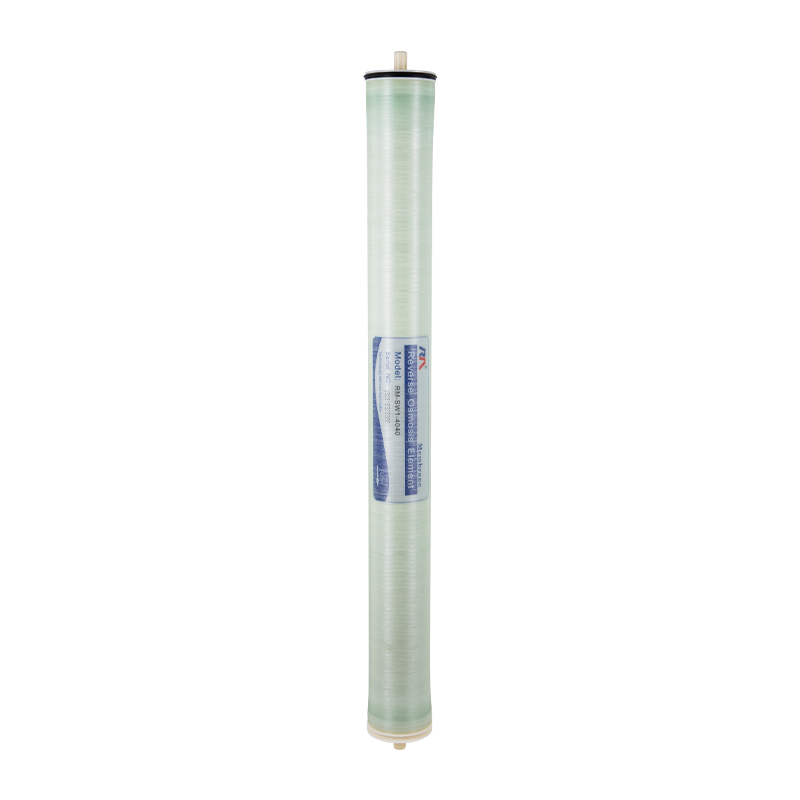
Standard SWRO spiral wound elements are 8 inches in diameter and 40 inches long (the industry-standard 8040 format), though 4-inch diameter elements (4040 format) are widely used for smaller systems such as yacht watermakers, island water supply systems, and industrial process water applications. Multiple elements are installed in series within a pressure vessel (typically 6–7 elements per vessel for 8-inch systems), with the concentrate from each element becoming the feed to the next, progressively concentrating the brine stream along the vessel length while permeate is collected from all elements simultaneously.
Hollow fiber seawater membranes consist of bundles of hair-thin hollow fiber membranes — each fiber being a self-supporting tube of polyamide or other membrane polymer approximately 50–300 microns in outer diameter — through which seawater is forced under pressure. Water permeates through the fiber wall while salt-rejected brine exits from the fiber lumen. Hollow fiber SWRO elements achieve very high packing density (large membrane area per unit volume) compared to spiral wound elements, which can reduce the physical footprint of a desalination system. However, hollow fiber seawater membranes are more susceptible to irreversible fouling and plugging than spiral wound elements because the narrow fiber lumens can block with suspended particles, and they are less widely used in contemporary large-scale desalination applications as a result.
Within the dominant 8040 spiral wound format, seawater membrane manufacturers have developed variants with progressively larger active membrane areas per element — achieved by using thinner feed spacers, tighter winding, and larger-diameter elements (16-inch diameter elements are now commercially available). High-productivity SWRO membrane elements with active areas of 400–440 ft² (37–41 m²) per 8040 element, compared to the earlier standard of 300–340 ft² per element, reduce the number of pressure vessels and elements required for a given production capacity, directly lowering capital cost and footprint. These high-area elements operate at higher permeate flux rates, which requires careful fouling management to prevent accelerated membrane fouling.
Seawater membrane datasheets contain a set of standardized performance parameters that allow engineers to compare products and predict system performance. Understanding what each parameter means and how it translates to real-world desalination system behavior is essential for informed membrane selection and performance monitoring.
| Parameter | Typical Range (SWRO) | What It Measures | Why It Matters |
| Salt Rejection (%) | 99.6% – 99.85% | % of dissolved salts rejected | Determines permeate water quality |
| Permeate Flow (m³/day) | 20 – 28 m³/day per 8040 | Freshwater output per element | Determines system sizing and cost |
| Operating Pressure (bar) | 55 – 70 bar | Required feed pressure | Drives pump sizing and energy use |
| Active Membrane Area (m²) | 37 – 41 m² per 8040 | Total filtration surface area | Influences flux and fouling rate |
| Max Operating Temp (°C) | 45°C | Feed water temperature limit | Critical for tropical/Gulf applications |
| pH Operating Range | 2 – 11 (operation); 1 – 13 (cleaning) | Tolerated pH range | Determines cleaning chemical options |
| Chlorine Tolerance | <0.1 mg/L (continuous) | Free chlorine exposure limit | Requires dechlorination before membrane |
Selecting the most appropriate seawater desalination membrane for a specific project requires a systematic evaluation of feed water chemistry, required permeate quality, system recovery target, energy constraints, and the operating environment. No single membrane product is universally optimal — the correct selection depends on matching membrane characteristics to the specific demands of each application.
Seawater salinity varies significantly by location — from approximately 33,000 mg/L TDS in cooler Atlantic waters to over 45,000 mg/L TDS in the Arabian Gulf, Red Sea, and certain enclosed coastal bays. Higher salinity means higher osmotic pressure, which requires higher operating pressure to achieve equivalent permeate flux — or alternatively, accepting lower system recovery. Feed water temperature also profoundly affects membrane performance: water viscosity decreases at higher temperatures, increasing membrane permeability and allowing higher permeate flow at the same operating pressure. However, higher temperature also reduces salt rejection, and most SWRO membranes have maximum operating temperature limits of 40–45°C. For high-temperature seawater sources, membrane selection must prioritize products with demonstrated stable salt rejection at elevated temperatures rather than simply maximizing low-temperature flux performance.
The permeate quality target influences membrane selection in terms of salt rejection specification. For potable water production to WHO drinking water guidelines, a single-pass SWRO system using membranes with 99.7–99.8% salt rejection typically produces permeate in the range of 200–400 mg/L TDS from standard seawater feed — acceptable after blending with a small proportion of bypass water and remineralization. For applications requiring ultra-pure water — pharmaceutical, semiconductor manufacturing, or high-pressure boiler feed — a two-pass RO arrangement using a second stage of lower-pressure brackish water membranes on the SWRO permeate may be necessary to achieve TDS levels below 50 mg/L. Boron rejection is a specific concern for agricultural irrigation and potable water applications, as standard polyamide SWRO membranes reject boron less efficiently than monovalent ions — specialized high-boron-rejection SWRO membranes or second-pass processing at elevated pH may be required where boron limits are stringent.
System recovery is the fraction of feed water that emerges as permeate product — expressed as a percentage. Typical SWRO system recovery ranges from 35% to 50% for single-stage systems, meaning 35–50 liters of fresh water is produced for every 100 liters of seawater fed to the system, with the balance leaving as concentrated brine. Higher recovery is economically attractive as it reduces energy consumption per unit of product water and minimizes brine disposal volume, but it concentrates feed-side salts and sparingly soluble minerals closer to their saturation limits, increasing scaling risk on the membrane surface. Membrane selection for high-recovery SWRO systems should prioritize products with established performance at the higher concentration polarization levels associated with elevated recovery, and antiscalant dosing and feed water chemistry management become even more critical at recovery rates above 45%.
Membrane fouling is the gradual accumulation of materials on or within the membrane surface that reduces permeate flux, increases pressure drop across membrane elements, and in severe cases causes irreversible deterioration of salt rejection performance. Fouling is the primary operational challenge in seawater reverse osmosis systems and the principal driver of cleaning frequency, chemical consumption, and ultimately membrane replacement costs. Understanding the distinct types of fouling that affect SWRO membranes and their root causes is the foundation of an effective prevention strategy.
Suspended particles, colloids, silt, clay, and fine organic debris in seawater can deposit on the feed spacer and membrane surface within spiral wound elements, progressively restricting flow channels and increasing differential pressure along the element. The Silt Density Index (SDI) is the standard measurement used to quantify the particulate fouling potential of SWRO feed water — an SDI15 value below 3 is the general target for spiral wound SWRO membranes, with values below 2 preferred for high-flux systems. Achieving a sufficiently low SDI requires adequate upstream pretreatment — typically coagulation, flocculation, and either conventional media filtration or ultrafiltration (UF) membranes as the pretreatment step immediately upstream of the SWRO system. Ultrafiltration pretreatment has become the industry standard for new large-scale SWRO plants due to its consistent ability to deliver SDI values below 2 regardless of raw seawater quality variations during algal bloom events, storms, and seasonal turbidity changes.
Biofouling — the formation of microbial biofilms on SWRO membrane and feed spacer surfaces — is widely considered the most problematic and difficult-to-control fouling type in seawater desalination. Seawater contains abundant marine microorganisms that readily attach to membrane surfaces, multiply, and produce extracellular polymeric substances (EPS) that form a coherent, adhesive biofilm layer. Even at very low cell concentrations, biofouling can develop into performance-limiting biofilms within days to weeks of system operation, causing significant flux decline and increased differential pressure. Standard disinfection with free chlorine cannot be used continuously with polyamide SWRO membranes because chlorine degrades the polyamide active layer — instead, non-oxidizing biocides (such as DBNPA or isothiazolones) are used for intermittent dosing, combined with regular cleaning-in-place (CIP) using biocidal cleaning formulations when biofouling indicators trigger intervention.
As water permeates through SWRO membranes, sparingly soluble mineral salts on the feed side become progressively concentrated. When their concentration exceeds the solubility limit, precipitation occurs on the membrane surface as scale — typically calcium carbonate, calcium sulfate, barium sulfate, strontium sulfate, or silica scale depending on the seawater chemistry and system recovery. Scale deposits physically block membrane pores and feed channels, causing flux decline and differential pressure increase that closely mimics particulate fouling in its symptoms but responds to entirely different cleaning chemistry. Antiscalant dosing — injecting scale inhibitor chemicals into the SWRO feed water at low concentrations (typically 2–5 mg/L) — is the primary preventive strategy, with acid dosing to control carbonate scaling as a supplementary measure where carbonate scaling risk is high.
The service life and cleaning frequency of SWRO membranes are directly determined by the quality of feed water delivered to them — which in turn is determined by the effectiveness of the upstream pretreatment system. Inadequate pretreatment is the single most common cause of premature SWRO membrane fouling, high cleaning frequency, and shortened membrane service life. Designing pretreatment to consistently deliver feed water meeting SWRO membrane manufacturer feed water quality requirements is as important as selecting the membranes themselves.
Despite best efforts in pretreatment and operation, SWRO membranes require periodic cleaning-in-place (CIP) to remove accumulated foulants and restore performance. The frequency and effectiveness of cleaning directly determines whether membranes achieve their expected service life of 5–10 years or require premature replacement due to irreversible fouling damage. Cleaning too infrequently allows fouling to consolidate into deposits that become progressively harder to remove; cleaning with incorrect chemistry fails to address the specific fouling type present and may cause unnecessary chemical stress on the membrane.
The standard industry trigger criteria for initiating SWRO membrane cleaning are: a 10–15% decline in normalized permeate flow (NPF) compared to the initial baseline at the same operating conditions, a 10–15% increase in normalized salt passage, or a 15% increase in normalized differential pressure across the membrane array — whichever is reached first. Normalizing these parameters to account for temperature, pressure, and feed concentration variations is essential for valid comparison over time; raw (unnormalized) values can mask developing fouling problems or trigger unnecessary cleaning interventions due to normal operational variability.
CIP cleaning involves circulating a heated cleaning solution (typically at 30–35°C) through the pressure vessels at low pressure and high flow velocity to dissolve, loosen, and flush foulants from the membrane and feed spacer surfaces. The choice of cleaning chemicals must match the fouling type: alkaline cleaners (high-pH detergent formulations with chelating agents) are effective against organic fouling and biofouling; acid cleaners (low-pH solutions such as citric acid or hydrochloric acid) address carbonate and metal oxide scale; enzymatic cleaners provide targeted degradation of protein and polysaccharide biofouling components. In practice, most SWRO membrane CIP procedures involve a sequential combination of alkaline and acid cleaning steps to address the mixed fouling layers that invariably develop in real seawater systems.
Systematic performance monitoring is essential for detecting fouling development at an early stage, identifying specific fouling types from the pattern of performance indicators, optimizing cleaning timing, and tracking long-term membrane condition trends that indicate when replacement should be planned. A well-designed SWRO monitoring program uses a combination of online instrumentation and periodic manual data collection to build a comprehensive performance history for each membrane array.
The economic case for extending SWRO membrane service life is compelling — membrane replacement represents a major recurring operational expense in desalination systems, and every additional year of service extracted from an existing membrane set directly reduces the lifecycle cost per cubic meter of water produced. The strategies that most effectively extend seawater membrane service life are consistently applied across the best-operated SWRO plants worldwide.
Maintaining optimal and stable operating flux is one of the most impactful practices for membrane longevity. Operating SWRO membranes at or near their design flux rather than at excessive flux rates reduces concentration polarization at the membrane surface — the local elevation of salt concentration immediately adjacent to the active layer that accelerates both scaling and biofouling. Most SWRO membrane manufacturers recommend average system flux rates of 10–14 L/m²h for seawater applications, with front elements (which receive the highest-quality, lowest-salinity feed) operating at the higher end of this range and tail elements at the lower end to account for the increased concentration factor along the pressure vessel.
Rigorous shutdown and preservation procedures protect membranes during planned and unplanned outages. SWRO membranes left standing in stagnant seawater or diluted feed water are highly susceptible to accelerated biofouling development during shutdown periods because the absence of the high cross-flow velocity that inhibits biofilm formation during normal operation allows rapid microbial colonization. For short shutdowns (less than 24 hours), flushing the membrane system with low-salinity permeate or dechlorinated freshwater displaces the high-salt feed and greatly reduces biofouling risk. For longer outages, preserving membranes in a sodium metabisulfite solution (0.5–1% SMBS) maintains an inhibitory environment for microbial growth throughout the shutdown period without damaging the polyamide membrane material.