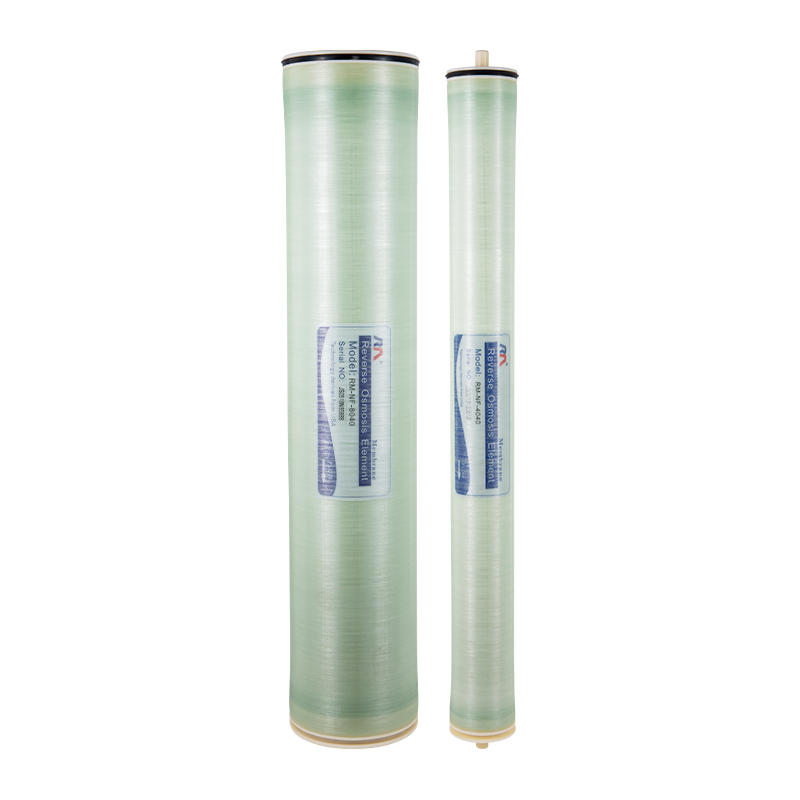
NF Membranes, or Nanofiltration membranes, represent a pivotal technology in the field of pressure-driven membrane separation processes. Positioned uniquely between Reverse Osmosis (RO) and Ultrafiltration (UF), NF Membranes offer a distinctive advantage: selective separation based on both size and ionic charge. This capability allows them to efficiently reject multivalent ions and larger organic molecules while maintaining a high flux for water and monovalent ions, making them indispensable across a wide range of industrial and environmental applications.
Principle of Operation
The core function of NF Membranes is governed by two main mechanisms: size exclusion (or steric hindrance) and Donnan exclusion (or charge effect).
-
Size Exclusion: NF Membranes typically have a pore size ranging from 0.5 to 2 nanometers (nm). This size allows them to effectively reject species with a molecular weight cutoff (MWCO) generally between 200 and 1,000 Daltons (Da). This capability is ideal for separating small organic molecules, pharmaceuticals, and larger dissolved solids.
-
Donnan Exclusion: Most commercially available NF Membranes are negatively charged on their surface. This charge creates an electrostatic repulsion, specifically rejecting negatively charged multivalent ions (like sulfate, SO42− or phosphate, PO43−), while allowing smaller, neutral, or monovalent ions (like chloride, Cl− or sodium, Na+) to pass more easily. This charge-based selectivity is what differentiates NF from simple sieve mechanisms like UF.
The combination of these two effects allows for a highly controlled separation, offering lower operating pressures than RO and better rejection than UF.
Key Applications of NF Membranes
The versatility and high selectivity of NF Membranes have led to their widespread adoption in various critical sectors:
Water Treatment and Desalination
NF Membranes are extensively used for water softening by removing divalent hardness ions (calcium Ca2+ and magnesium Mg2+). They are also a crucial pre-treatment step for RO systems, removing natural organic matter (NOM) and reducing the fouling potential. In brackish water desalination, NF offers an energy-efficient alternative to RO when partial salt removal is sufficient and the retention of monovalent ions is not strictly required.
Industrial Process Water
In the pharmaceutical, textile, and food and beverage industries, NF Membranes are essential for:
-
Color Removal: Eliminating synthetic dyes and pigments from wastewater streams.
-
Product Concentration and Purification: Fractionating complex mixtures, such as concentrating sugars or separating amino acids.
-
Minimizing Waste: Recovering valuable chemicals and salts from process streams, contributing to zero-liquid discharge (ZLD) goals.
Environmental Remediation
NF Membranes are highly effective in environmental applications, particularly for the removal of emerging contaminants, including pharmaceuticals and personal care products (PPCPs), and certain pesticides and herbicides from water sources, thus safeguarding ecosystems and public health.
Challenges and Future Directions
Despite their advantages, the long-term operational viability of NF Membranes is constantly challenged by membrane fouling—the deposition of materials on the membrane surface, which decreases flux and separation efficiency. Research efforts are intensely focused on:
-
Novel Membrane Materials: Developing new materials, such as thin-film nanocomposite (TFN) membranes incorporating nanoparticles (e.g., graphene oxide, TiO2), to enhance permeability, selectivity, and fouling resistance.
-
Surface Modification: Employing advanced techniques to modify the membrane surface charge and hydrophilicity, making them less susceptible to organic and biological fouling.
-
Optimized System Design: Integrating NF with other separation technologies in hybrid systems to maximize efficiency and minimize energy consumption.
In conclusion, NF Membranes are a core component of sustainable water management and chemical processing. Their ability to deliver high selectivity at moderate pressures secures their role as a critical, high-performance separation technology for the challenges of today and the future.



 English
 عربى
عربى