English
 عربى
عربى
News
Home / News / Industry News / PAN UF Membranes Explained: A Practical Guide to How They Work and Where They're Used
Content
PAN UF membranes are ultrafiltration membranes made from polyacrylonitrile, a polymer valued for its strength, chemical resistance, and ability to form a consistent pore structure. In simple terms, these membranes act as a fine physical barrier that separates particles, bacteria, and large molecules from water or other liquids while allowing smaller molecules to pass through. The "UF" in the name stands for ultrafiltration, a filtration range that sits between microfiltration and nanofiltration, capable of removing substances as small as certain proteins and viruses without needing the higher pressure required by reverse osmosis.
What makes polyacrylonitrile a popular choice for ultrafiltration is its natural resistance to oxidizing agents like chlorine, combined with good mechanical strength and thermal stability. These properties mean that PAN membranes can handle more aggressive cleaning routines and harsher operating conditions than many other membrane materials, which translates into a longer service life and fewer replacements over time.
Most PAN UF membranes are produced using a technique called phase inversion, where a polymer solution is cast into a thin layer or spun into hollow fibers and then immersed in a coagulation bath. As the solvent and non-solvent exchange, the polymer solidifies into a porous structure with a dense, selective top layer and a more open, sponge-like support layer underneath. This asymmetric structure is what gives the membrane both its filtration precision and its mechanical durability.
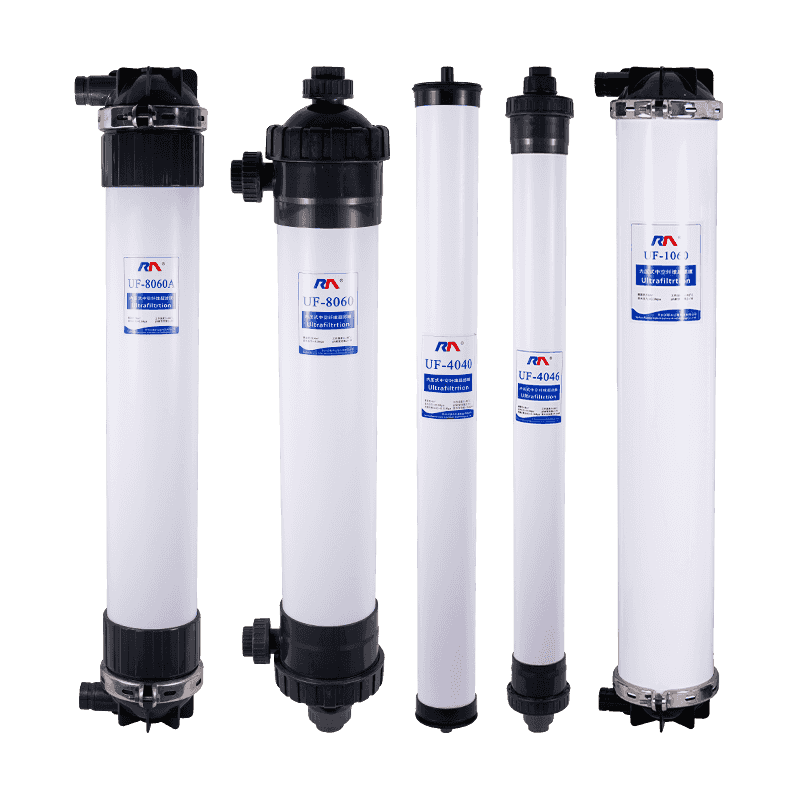
PAN UF membranes are commonly manufactured in hollow fiber form, which packs a large filtration surface area into a compact module and is well suited for high-volume water treatment applications. Flat sheet configurations are also available and tend to be used in smaller-scale or specialty filtration systems where module design flexibility matters more than sheer throughput.
Choosing a membrane material means weighing several performance factors at once, and PAN consistently scores well across most of them. The table below breaks down the main properties that matter for real-world filtration applications.
| Property | Performance Characteristic | Practical Benefit |
| Chlorine Resistance | Good tolerance to oxidizing chemicals | Allows more aggressive chemical cleaning |
| Mechanical Strength | High tensile strength for a polymer membrane | Withstands higher operating pressures without cracking |
| Thermal Stability | Stable performance at elevated temperatures | Suitable for warmer process streams |
| Hydrophilicity | Naturally hydrophilic surface | Lower fouling tendency compared to hydrophobic membranes |
| Pore Size Control | Consistent pore distribution during manufacturing | Reliable, repeatable filtration performance |
The combination of durability and filtration precision makes PAN ultrafiltration membranes suitable for a wide range of industries, many of which deal with demanding or variable feed water conditions.
Ultrafiltration membranes are typically rated by molecular weight cut-off, which indicates the smallest size of particle or molecule the membrane can reliably reject. Choosing a membrane with too tight a cut-off can lead to unnecessarily high pressure requirements and lower flux, while too loose a cut-off risks letting unwanted contaminants through.
Water with high organic content or heavy suspended solids will foul membranes faster regardless of material. In these cases, it helps to pair a PAN UF membrane with adequate pre-treatment, such as coarse filtration or coagulation, to extend the membrane's operating life between cleaning cycles.
Hollow fiber modules are generally favored for large-scale water treatment due to their compact footprint and high packing density, while flat sheet or other configurations might better suit specialized lab-scale or niche industrial setups. Confirming that the chosen module fits existing system piping, housing, and flow requirements avoids costly retrofitting later.
Like any filtration technology, PAN UF membranes perform best when given regular attention rather than left to run until problems appear. Backwashing on a scheduled basis flushes accumulated particles off the membrane surface and helps maintain consistent flux over time. Many systems automate this process, running a backwash cycle every 20 to 60 minutes depending on feed water quality and system design.
Chemical cleaning is another important part of long-term maintenance, typically performed when transmembrane pressure rises beyond a set threshold or flux drops noticeably. Because PAN membranes tolerate chlorine-based cleaning agents reasonably well, operators have more flexibility in choosing cleaning chemistries compared to membranes made from more sensitive polymers. That said, following the manufacturer's recommended chemical concentrations and exposure times still matters, since excessive or prolonged exposure can gradually degrade even a resistant membrane.
Monitoring integrity through regular pressure decay tests or bubble point testing also helps catch small fiber breaks or defects before they become larger performance issues. Catching these early keeps the filtration system reliable and avoids unexpected downtime.
PAN UF membranes offer a strong balance of chemical resistance, mechanical durability, and consistent filtration performance, making them a dependable choice across water treatment, food processing, and biotech applications. Getting the most out of them comes down to selecting the right pore size and module format for your specific feed water, pairing the membrane with suitable pre-treatment, and sticking to a consistent backwashing and cleaning schedule. With the right setup and care, these membranes can deliver years of stable, efficient filtration performance.