English
 عربى
عربى
News
Home / News / Industry News / Ultra Low Pressure Membranes Explained: Save Energy Without Sacrificing Water Quality
Content
Ultra low pressure membranes are a class of thin-film composite (TFC) membranes engineered to achieve effective salt and contaminant rejection at significantly reduced operating pressures compared to conventional reverse osmosis (RO) membranes. While standard RO systems typically require transmembrane pressures of 10–17 bar (150–250 psi) for brackish water applications, ultra low pressure RO membranes are designed to operate effectively at 3–7 bar (45–100 psi) — sometimes even lower in purpose-built configurations.
This pressure reduction is not simply a matter of running a standard membrane at lower force. Ultra low pressure (ULP) membranes are structurally and chemically distinct. They feature a thinner, more permeable active polyamide layer formed through optimized interfacial polymerization, which allows water molecules to pass through more freely at lower driving force while still rejecting dissolved solids. The result is a membrane that delivers high water flux — typically 30–50% higher than standard RO at equivalent pressure — without compromising rejection rates for target contaminants.
The term covers several overlapping product categories depending on the manufacturer. Some suppliers label their offerings as "low energy RO membranes," "energy-saving membranes," or "low-pressure nanofiltration membranes," but the underlying engineering principle is the same: maximize permeability to reduce the pump work required to move water through the system. Understanding what separates ULP membranes from adjacent technologies — particularly nanofiltration (NF) — is essential before specifying one for a project.
Ultra low pressure membranes occupy a specific position in the pressure-driven membrane spectrum. To choose the right technology, it helps to understand how ULP membranes perform relative to their closest neighbors — conventional RO and NF.
| Parameter | Nanofiltration (NF) | Ultra Low Pressure RO | Standard RO |
|---|---|---|---|
| Typical Operating Pressure | 3–10 bar | 3–7 bar | 10–17 bar |
| NaCl Rejection | 40–70% | 95–99% | 97–99.7% |
| Divalent Ion Rejection | 85–98% | 98–99.5% | 99–99.8% |
| Water Flux (LMH at rated pressure) | 20–60 | 30–55 | 15–40 |
| Energy Consumption (relative) | Low | Low–Medium | Medium–High |
| Suitable for Seawater Desalination | No | No (brackish only) | Yes (SWRO variant) |
The critical distinction between ULP RO and nanofiltration lies in monovalent ion rejection. NF membranes allow a significant fraction of sodium and chloride ions to pass through, making them unsuitable where low total dissolved solids (TDS) are required. Ultra low pressure RO membranes maintain high rejection across both monovalent and divalent ions, delivering permeate quality comparable to standard RO but at a fraction of the energy cost — provided the feed TDS is within the brackish range (typically below 5,000–10,000 mg/L).
Energy is the dominant operating cost in any pressure-driven membrane system, often accounting for 30–50% of total lifecycle cost in large installations. The pump work required to push water through a membrane scales directly with operating pressure, so halving the pressure requirement has an immediate and significant impact on electricity consumption.
A standard brackish water RO system treating feed water at 2,000 mg/L TDS might operate at 10–12 bar, consuming approximately 0.5–1.0 kWh per cubic meter of permeate produced. An equivalent ultra low pressure RO system processing the same feed at 4–5 bar can reduce this to 0.2–0.5 kWh/m³ — a reduction of 40–60% in pump energy alone. At industrial scale, where systems may produce thousands of cubic meters per day, this translates to substantial annual savings in electricity costs and carbon emissions.
The savings compound further when considering pump sizing and infrastructure. Lower operating pressure allows the use of smaller, less expensive high-pressure pumps — or in some cases, eliminates the need for a high-pressure pump entirely in favor of a standard centrifugal pump. This reduces both capital expenditure and maintenance costs associated with pressure management equipment. Energy recovery devices, commonly used in high-pressure SWRO systems, may not be necessary at ULP operating ranges, simplifying system design.
However, the energy benefit of low pressure RO membranes is feed-water dependent. As TDS increases toward the upper brackish range, the osmotic pressure of the feed increases and the operational pressure advantage narrows. A system designed around ULP membranes must be carefully matched to the anticipated feed water quality — ideally with some design margin for seasonal or source-driven TDS fluctuations.
Low energy RO membranes are not universally applicable — their advantages are most pronounced in specific contexts where feed water salinity is moderate and energy cost is a primary concern.
Where source water TDS is below 1,500 mg/L — typical of many municipal supplies, surface waters, and secondary wastewater effluent — ultra low pressure membranes are an excellent fit. Potable water reuse schemes increasingly rely on ULP RO as a core treatment barrier, combining high pathogen and contaminant rejection with the low energy footprint needed to make indirect or direct potable reuse economically viable. Several large-scale water recycling facilities in water-stressed regions have adopted ULP configurations to reduce their specific energy consumption to below 0.3 kWh/m³.
Hospitals, hotels, food and beverage manufacturers, and pharmaceutical facilities all require consistent high-purity water but typically work with municipal-quality feed water. For these users, ultra low pressure RO systems offer a compelling combination: the permeate quality of full RO treatment, smaller and simpler pumping equipment, and meaningfully lower electricity bills over the system's operational lifetime. Systems in this sector are often skid-mounted and compact — facilitated by the reduced pressure ratings required for ULP configurations — making installation more straightforward and flexible.
Perhaps the most compelling use case for ultra low pressure membranes is in decentralized, renewable-energy-powered water treatment. Solar-powered RO systems are increasingly deployed in remote communities, island settlements, and emergency response scenarios. At standard RO operating pressures, solar-powered systems require large photovoltaic arrays and battery storage to handle variable irradiance — adding cost and complexity. ULP membranes reduce the power demand enough that smaller, simpler solar systems become feasible. Several humanitarian organizations and research institutions have demonstrated solar-powered ULP RO units capable of producing safe drinking water from brackish groundwater at energy inputs below 1 kWh/m³ including all auxiliary systems.
Industrial facilities using demineralized water for boiler feed or cooling tower makeup often draw from low-to-moderate TDS sources. Ultra low pressure RO membranes are well-suited here because the feed quality is typically within their optimal operating range, and the continuous, high-volume nature of industrial water demand makes energy efficiency a significant cost driver. ULP systems in these applications are often staged in two-pass configurations, where a second pass further reduces TDS and silica levels without dramatically increasing overall energy consumption.
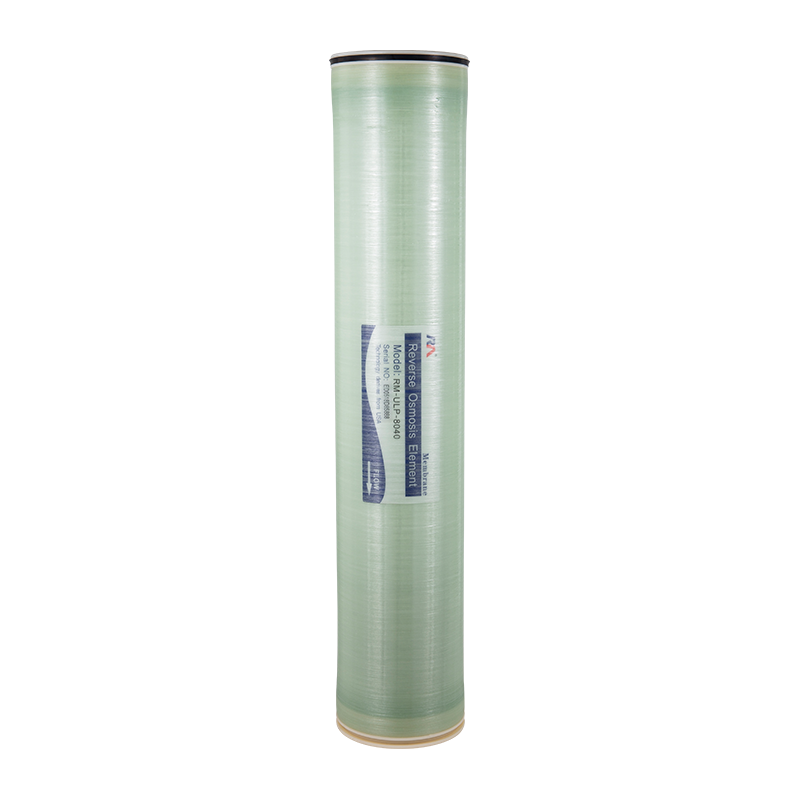
Manufacturers publish standard test conditions for ULP membranes — typically at 250 mg/L NaCl, 25°C, 15% recovery, and a specified applied pressure — but real-world performance depends on many site-specific factors. These are the parameters that matter most when comparing products and sizing a system.
Operating at lower pressure changes the fouling dynamics of an RO system in ways that aren't always immediately obvious. Understanding these risks helps operators design appropriate pretreatment and monitoring protocols.
The lower operating cost of ULP systems sometimes encourages operators to push system recovery rates higher — extracting more permeate from the same volume of feed. While this reduces water waste and concentrate disposal costs, it also concentrates dissolved ions, silica, and organic matter in the reject stream and increases concentration polarization at the membrane surface. For scale-forming species like calcium carbonate, calcium sulfate, and silica, higher recovery dramatically increases the scaling risk. Anti-scalant dosing and careful Langelier Saturation Index (LSI) management become even more critical when targeting recoveries above 75–80% with ULP membranes.
Polyamide thin-film composite membranes — including all major ULP RO membranes — are sensitive to free chlorine, which degrades the active layer and causes irreversible rejection loss. This means feed water must be dechlorinated prior to the membrane, typically using sodium metabisulfite or activated carbon. Without residual chlorine, microorganisms can colonize the membrane surface and form biofilms. ULP systems treating biologically active feed waters (surface water, treated wastewater) should incorporate upstream disinfection, appropriate biofilm control strategies, and regular biocide cleaning cycles to prevent productivity loss from biofouling.
Despite their gentler operating conditions, ultra low pressure membranes still require effective pretreatment. Silt density index (SDI) of the feed water should be maintained below 5, and ideally below 3, to prevent colloidal fouling. Upstream ultrafiltration or microfiltration is increasingly used as a pretreatment stage for ULP RO systems, particularly in surface water and wastewater reuse applications, producing a consistent, low-SDI feed regardless of raw water quality variability. Cartridge filtration (5-micron) remains the minimum recommended pretreatment for any spiral wound RO element.
Several major membrane manufacturers produce well-established ultra low pressure RO product lines. While specific performance figures should always be verified against current datasheets, the following represents the general landscape of commercially available low energy RO membranes.
When comparing products, always request performance data at conditions that match your actual feed water chemistry and temperature — not just the standard test conditions. Most manufacturers offer free system design software (such as DuPont's WAVE or Toray's TorayDS) that allows projection of real-world flux, rejection, and energy consumption based on site-specific inputs.
Specifying the right membrane is only half the equation. Operational discipline and system design choices have a major influence on whether a ULP system delivers on its energy-saving potential over the long term.