English
 عربى
عربى
News
Home / News / Industry News / Breaking the Energy Barrier: Why ULP Membranes are the Future of Sustainable Desalination
Content
Ultra-Low Pressure (ULP) membranes represent a significant leap in thin-film composite (TFC) technology, specifically engineered to operate at significantly lower feed pressures than standard reverse osmosis (RO) membranes. These membranes are designed with a more porous support layer and a highly permeable polyamide active layer, allowing water molecules to pass through at pressures as low as 100 to 150 psi. By reducing the mechanical energy required to overcome osmotic pressure, ULP membranes address the primary cost driver in water treatment: electricity consumption. This makes them an ideal solution for treating feed water with lower salinity levels, such as tap water, brackish groundwater, or tertiary treated wastewater.
The fundamental advantage of ULP technology lies in its surface chemistry. Manufacturers utilize advanced interfacial polymerization techniques to create a membrane surface that is smoother and more hydrophilic than traditional variants. This increased hydrophilicity not only facilitates higher water flux but also reduces the affinity for organic foulants. Consequently, systems utilizing ULP membranes experience less frequent cleaning cycles and lower operational downtime, contributing to a more sustainable and cost-effective water purification lifecycle.
When evaluating ULP membranes, engineers focus on the balance between "flux" (the rate of water permeation) and "rejection" (the percentage of contaminants removed). While high-pressure membranes prioritize maximum salt rejection for seawater, ULP membranes optimize for high flow rates in low-salinity applications. The table below outlines the typical performance characteristics found in industrial-grade ULP elements.
| Parameter | Standard RO Membrane | ULP RO Membrane |
| Operating Pressure | 225 - 400 psi | 100 - 150 psi |
| Average Salt Rejection | 99.5% - 99.7% | 98.0% - 99.2% |
| Energy Consumption | High | Ultra-Low |
| Primary Application | High TDS / Seawater | Low TDS / Tap Water |
ULP membranes are most effective when the feed water TDS is below 2,000 ppm. At higher concentrations, the osmotic pressure of the solution increases to a point where the "ultra-low" pressure is insufficient to drive permeation, which can lead to rapid flux decline and potential scaling on the membrane surface.
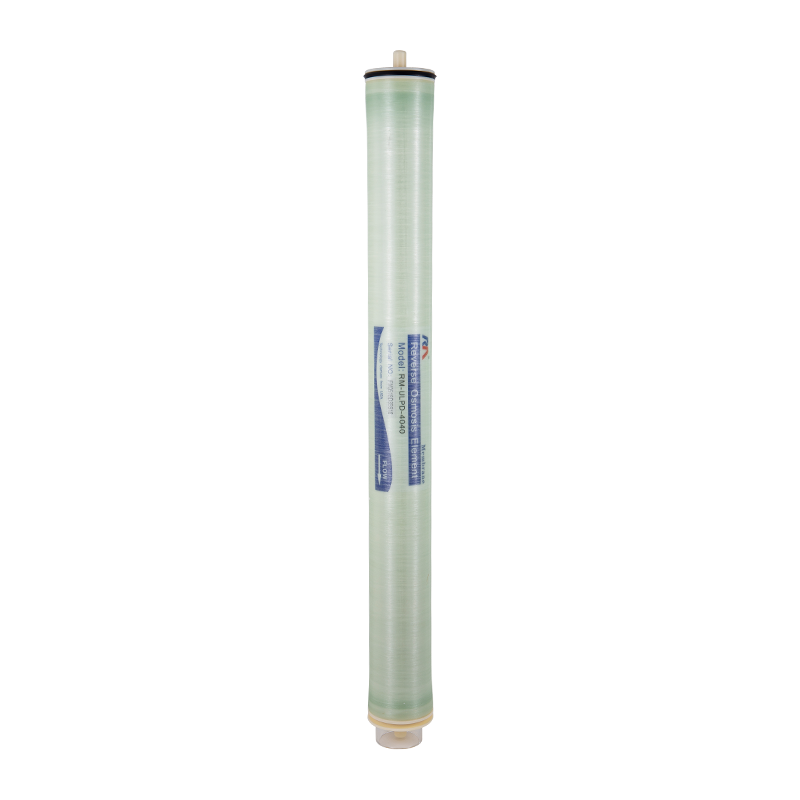
Transitioning to ULP membranes offers multi-layered advantages for facility managers and system integrators. Beyond simple energy savings, these components influence the entire physical footprint and hardware requirements of a water treatment plant.
To maximize the lifespan of ULP membranes—which typically ranges from 3 to 5 years—proper pretreatment and monitoring are essential. Because these membranes are highly permeable, they can be more sensitive to physical "plugging" if suspended solids are not effectively removed during the filtration stage. Implementing a robust pretreatment string involving multi-media filters or ultrafiltration (UF) is highly recommended.
ULP membranes are sensitive to oxidizing agents like chlorine, which can permanently damage the polyamide layer and cause rejection rates to plummet. Always ensure that dechlorination via activated carbon or sodium bisulfite injection is verified before the water reaches the RO stage. When performing Clean-In-Place (CIP) procedures, use pH-buffered cleaners specifically formulated for TFC membranes to avoid delamination of the active layer.
Regular normalization of performance data is also vital. By tracking temperature-corrected flow and pressure, operators can distinguish between "normal" fouling and genuine membrane degradation, allowing for proactive rather than reactive maintenance strategies.