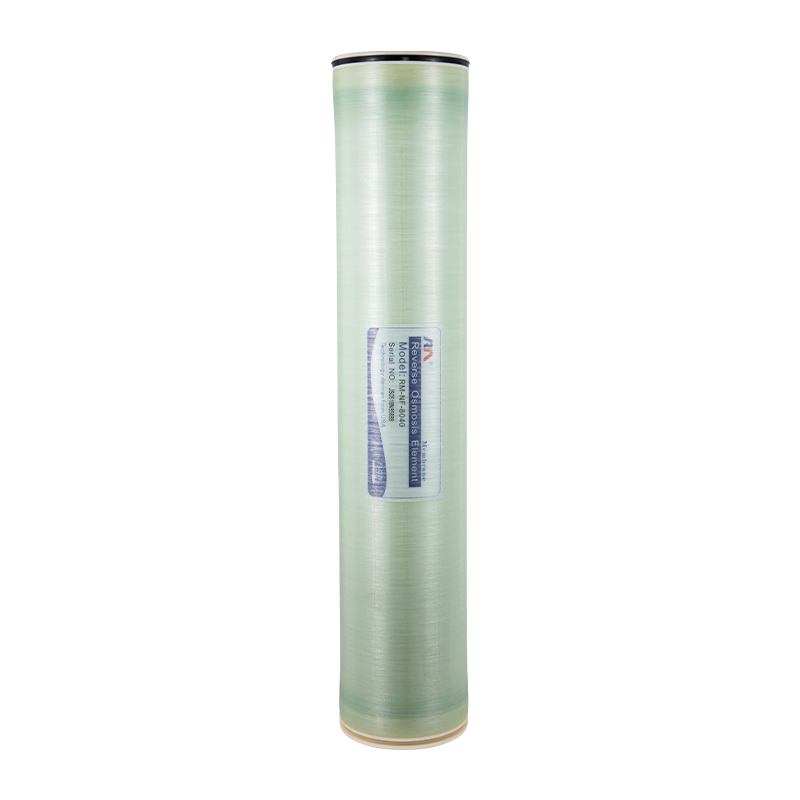
NF Membranes (Nanofiltration Membranes) represent a critical and versatile technology in modern water and wastewater treatment. Positioned uniquely between Reverse Osmosis (RO) and Ultrafiltration (UF) in terms of pore size and operational pressure, NF Membranes offer a distinct separation capability: selectively rejecting multivalent ions and larger contaminants while efficiently allowing monovalent ions and water to pass through.
Understanding Nanofiltration Technology
Nanofiltration is a pressure-driven membrane separation process. The term "nanofiltration" directly relates to the typical pore size range of these membranes, which spans approximately 0.5 to 10 nanometers (nm). This precise range allows NF Membranes to achieve high retention of multivalent ions (like hardness-causing Ca2+ and Mg2+), natural organic matter (NOM), color, and some low-molecular-weight solutes, all while maintaining a lower operating pressure compared to RO systems.
Separation Mechanism
The rejection mechanism employed by NF Membranes is a sophisticated combination of two principal effects:
-
Size Exclusion (Steric Hindrance): Like UF, the physical pore size prevents particles and molecules larger than the membrane pores from passing. Given the fine structure of NF Membranes, this is highly effective for NOM and compounds with a molecular weight cutoff (MWCO) typically between 150 and 500 Daltons.
-
Donnan Effect (Charge Repulsion): This is the signature feature of NF. Most commercial NF Membranes are negatively charged. This surface charge creates electrostatic repulsion against co-ions (ions of the same charge, particularly divalent anions like SO42−), significantly boosting the rejection of multivalent species. Consequently, monovalent anions (e.g., Cl−) are rejected less effectively.
This combined steric and charge-based mechanism enables NF Membranes to achieve excellent rejection for salts containing divalent ions (e.g., MgSO4) but a deliberately lower rejection for salts composed only of monovalent ions (e.g., NaCl) when compared to the near-total rejection achieved by RO.
Key Applications of NF Membranes
The selective nature and reduced energy demand of NF Membranes make them ideal for a diverse spectrum of municipal and industrial applications.
Water Softening and Hardness Removal
One of the most widespread uses of NF Membranes is the removal of water hardness. Since hardness is primarily caused by divalent cations (Ca2+ and Mg2+), NF Membranes efficiently isolate these ions, yielding softened water without the need for traditional chemical softening or the brine waste associated with ion exchange regeneration.
Disinfection Byproduct (DBP) Precursor Control
Natural Organic Matter (NOM) in source water is the precursor to harmful Disinfection Byproducts (DBPs) when water is chlorinated. NF Membranes are highly proficient at removing NOM, serving as a critical barrier against DBP formation and significantly enhancing the quality and safety of treated drinking water.
Water Reclamation and Reuse
In advanced wastewater treatment, NF Membranes are employed for tertiary treatment and water reclamation. They are capable of selectively recovering valuable resources or removing targeted contaminants, heavy metals, and emerging pollutants, facilitating the safe reuse of water in industrial, agricultural, and sometimes potable applications.
Industrial Separations
NF Membranes are essential across various industrial sectors:
- Dye Manufacturing: Efficiently desalting high-value dye products.
- Food and Beverage: Concentration and purification of specific compounds, such as in dairy or sugar production.
- Metal Finishing: Recovering precious metals and recycling process rinse waters.
Advantages and Operational Challenges
The growing adoption of NF Membranes is a testament to their advantages, but effective system management requires anticipating and addressing common operational hurdles.
| Feature |
Benefit |
| Lower Energy Consumption |
Operates at significantly lower pressures than RO, leading to reduced energy costs. |
| High Selectivity |
Allows targeted removal of specific ions (e.g., divalent) while retaining desirable components (e.g., monovalent ions). |
| High Water Recovery |
Often permits higher net water recovery rates than standard RO systems. |
| Excellent Pretreatment |
Superior efficacy in removing color, organic matter, and DBP precursors. |
Operational Challenges
The primary challenge facing all pressure-driven membrane systems, including those using NF Membranes, is fouling. Fouling occurs when retained materials accumulate on the membrane surface, causing permeate flux decline and requiring higher operating pressure. Optimal system design necessitates robust pretreatment and consistent, effective chemical cleaning protocols to preserve the performance and extend the lifespan of NF Membranes. Furthermore, system operators must carefully manage chemical stability and pH levels, as the material of construction (e.g., polyamide thin-film composite) dictates the membrane's specific tolerance limits.
Conclusion
NF Membranes are an established and essential technology in the water treatment landscape. By smartly bridging the gap between ultrafiltration and reverse osmosis, they provide an energy-efficient, highly selective, and flexible solution for diverse applications—from municipal water supply to complex industrial separations. Ongoing research is continuously focused on improving the anti-fouling characteristics and chemical resilience of NF Membranes, ensuring their continued and increasingly efficient role in sustainable global water management.



 English
 عربى
عربى