English
 عربى
عربى
News
Home / News / Industry News / Which category of contaminants is an Ultrafiltration system most effective at removing?
The field of water treatment is constantly evolving, with advanced technologies playing a critical role in ensuring the safety and purity of water sources. Among these, Ultrafiltration (UF) systems stand out, particularly for their exceptional efficacy in targeting a specific category of contaminants.
An Ultrafiltration system is most effective at removing Particulate Matter, Suspended Solids, and Microbiological Contaminants. This category includes:
Bacteria: UF membranes provide an exceptionally strong barrier against almost all types of waterborne bacteria, achieving high log reduction values (often -log removal).
Viruses: Due to their pore size, which typically ranges from to micrometers (m), UF systems are highly effective at blocking the vast majority of viruses, which are significantly larger than the membrane pores.
Protozoa/Cysts: Larger pathogens likeGiardiaandCryptosporidiumare completely removed by the physical sieving action of the membrane.
Colloids and High Molecular Weight Organics: Suspended solids, turbidity-causing particles, and larger organic macromolecules are efficiently rejected, leading to water with very low silt density and high clarity.
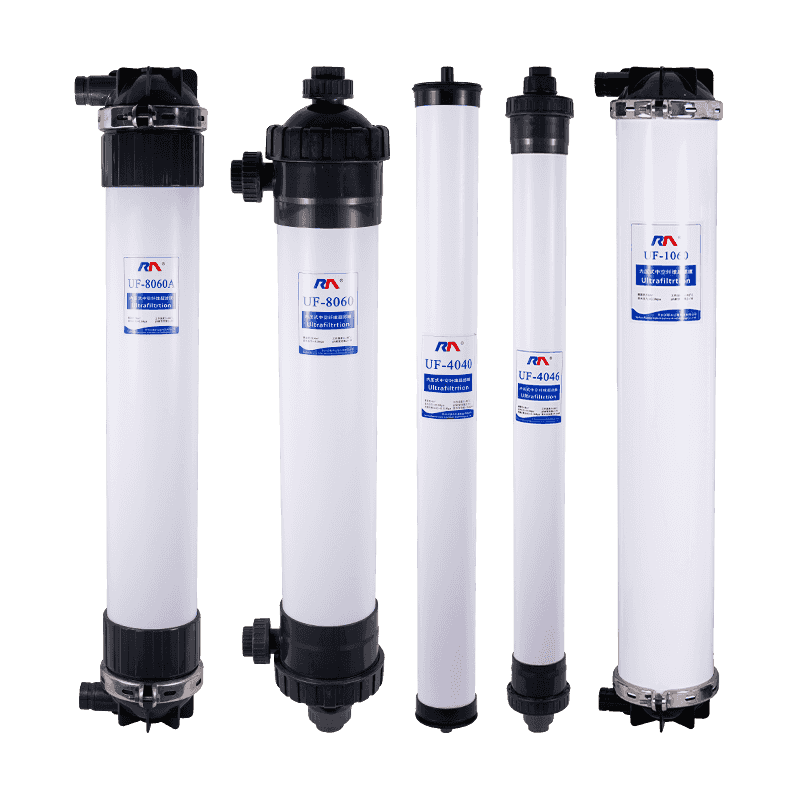
The heart of the system is the UF (Ultrafiltration) Membranes themselves. These membranes operate on a pressure-driven, size-exclusion principle—they act as a physical barrier.
Pore Size and Mechanism: The tightly controlled pore structure ensures that all particles and microorganisms larger than the specified cut-off are retained on the feed side of the membrane, while purified water (the permeate) and smaller dissolved molecules (like salts and beneficial minerals) pass through. This physical sieving mechanism is inherently reliable and does not rely on chemical addition.
Hollow Fiber Configuration: Most modern UF systems utilize hollow fiber modules. Water flows either from the outside-in or inside-out of these fibers. This design offers a massive surface area within a compact module, enabling high flow rates and efficient filtration for both industrial and municipal applications.
System Advantages: Unlike Reverse Osmosis (RO), which removes dissolved salts, UF operates at significantly lower pressures, leading to lower energy consumption and operational costs. Furthermore, UF allows beneficial dissolved minerals to remain in the water, which is often desirable in drinking water applications. The system's robustness is further enhanced by its ability to be periodically back-flushed or chemically cleaned to remove the accumulated contaminants, restoring the membrane's flux and ensuring a long service life.
The high efficacy of UF systems in removing particulates and pathogens makes them indispensable in several key sectors:
Municipal Water Treatment: Providing a critical barrier for drinking water, often used to treat surface water sources before distribution.
Pre-treatment for RO: UF is an excellent pre-filter for Reverse Osmosis (RO) systems. By removing suspended solids and biological foulants, it protects the much finer RO membranes from clogging, extending their lifespan, and reducing cleaning frequency.
Wastewater Reuse: Treating industrial and municipal wastewater to a high quality, making it suitable for non-potable reuse applications.
Food and Beverage Industry: Used for clarification, sterilization, and concentration processes (e.g., juice clarification, protein separation).
In conclusion, while UF systems are highly versatile, their core strength and area of maximum effectiveness are in the physical removal of suspended solids, colloids, and, most critically, microbiological threats like bacteria and viruses, providing a reliable solution for clean and safe water.