English
 عربى
عربى
News
Home / News / Industry News / UF Membranes Explained: How Ultrafiltration Cleans Water and Why It Matters
Content
UF Membranes, short for ultrafiltration membranes, are filtration barriers with extremely small pores, typically ranging from 0.01 to 0.1 microns, that physically block bacteria, viruses, suspended solids, and large organic molecules while allowing water and dissolved salts to pass through. They sit in the filtration spectrum between microfiltration and nanofiltration, making them fine enough to remove most pathogens and turbidity-causing particles without requiring the high pressure needed for reverse osmosis systems.
Because UF Membranes rely on size exclusion rather than chemical treatment, they remove contaminants through a purely physical barrier process. Water is pushed or pulled through the membrane's microscopic pores, and anything larger than the pore size simply cannot pass, regardless of its chemical properties.
UF Membranes are manufactured from a handful of different polymer materials, and the configuration in which they're built affects how they're installed and maintained in a treatment system.
Polyvinylidene fluoride, commonly known as PVDF, is one of the most widely used materials for ultrafiltration membranes due to its strong chemical resistance and durability under repeated cleaning cycles. Polyethersulfone, or PES, is another common choice, often favored for its high flux rates and lower production cost, though it can be slightly less resistant to certain aggressive cleaning chemicals compared to PVDF.
Most modern UF Membranes are built in a hollow fiber format, where thousands of thin, straw-like fibers are bundled together inside a module housing. Water flows either from the outside of the fibers inward, known as outside-in flow, or from the inside outward, known as inside-out flow, depending on the system design and the type of feed water being treated.
While less common than hollow fiber designs, flat sheet membranes arranged in cassette or spiral wound configurations are sometimes used in specific industrial applications where space constraints or particular fouling characteristics make hollow fiber modules less practical.
Choosing the right filtration technology for a water treatment project means understanding how UF Membranes stack up against other common membrane types in terms of pore size, removal capability, and energy requirements.
| Filtration Type | Pore Size | What It Removes | Operating Pressure |
| Microfiltration | 0.1 to 10 microns | Sediment, large bacteria, protozoa | Low |
| Ultrafiltration | 0.01 to 0.1 microns | Bacteria, viruses, colloids, large proteins | Low to Moderate |
| Nanofiltration | 0.001 to 0.01 microns | Divalent ions, small organic molecules | Moderate |
| Reverse Osmosis | Less than 0.001 microns | Dissolved salts, virtually all dissolved solids | High |
This comparison highlights why UF Membranes are often chosen as a pretreatment step before reverse osmosis systems. They remove the bacteria, viruses, and suspended particles that would otherwise foul a reverse osmosis membrane quickly, extending the lifespan and performance of the more expensive downstream treatment stage.
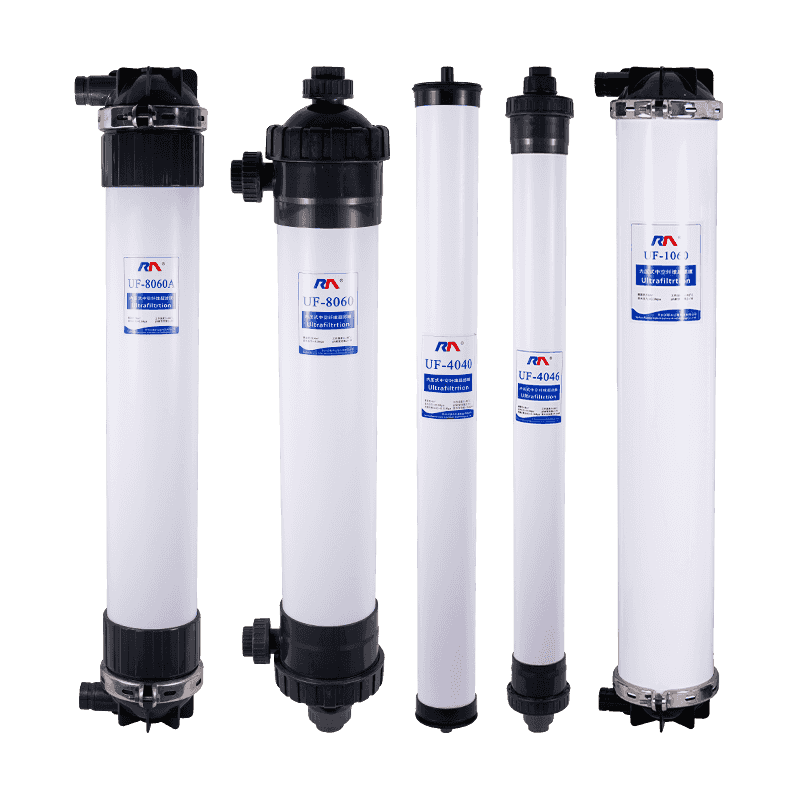
Ultrafiltration technology has found its way into a wide range of industries beyond municipal drinking water treatment, largely because of its reliability and relatively low energy requirements compared to higher-pressure filtration methods.
Membrane fouling is one of the biggest ongoing challenges in operating a UF Membranes system, occurring when particles, organic matter, or microbial growth accumulate on the membrane surface and reduce flow rates over time.
Organic matter and biofilm growth are among the most common fouling culprits, particularly in surface water and wastewater applications. Regular backwashing cycles, where water flow is briefly reversed to dislodge accumulated material, help manage this type of fouling before it becomes severe enough to require chemical cleaning.
In feed water with high mineral content, scale deposits can form on membrane surfaces over time. Pretreatment steps like coagulation or pH adjustment, combined with periodic chemical cleaning using acid or alkaline solutions, help keep mineral scaling under control and maintain consistent permeate flow.
Proper operation and maintenance significantly extend the usable life of UF Membranes, which represent a meaningful capital investment in most water treatment systems.